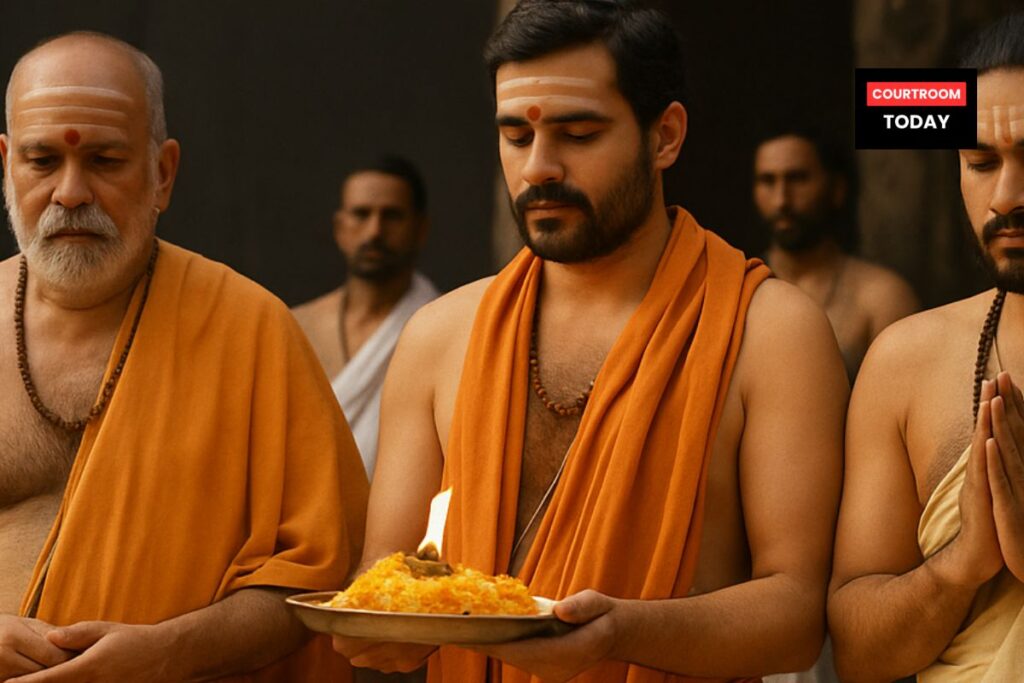
The Kerala High Court has ruled that the appointment of temple priests (santhis) cannot be restricted to any particular caste or family lineage. The Court held that such restrictions do not amount to an essential religious practice and, therefore, cannot claim protection under the Constitution of India.
A Division Bench of Justice Raja Vijayaraghavan V and Justice KV Jayakumar delivered the ruling while upholding the decision of the Travancore Devaswom Board (TDB) and the Kerala Devaswom Recruitment Board (KDRB) to accept experience certificates issued by ‘Thanthra Vidyalayas’ for the recruitment of part-time temple priests.
Background of the Case
The case was filed by the Akhila Kerala Thanthri Samajam, a society of around 300 traditional Thanthri families in Kerala. The society, along with its president, Easanan Namboodiripad, challenged the recruitment of temple priests through candidates certified by Thanthra Vidyalayas.
They questioned the legality of Qualification No. 2(ii) under Rule 6(1)(b) of the Travancore Devaswom Board Officers’ and Servants’ Service Rules, 2022. This rule allows candidates with a “certificate in Santhi Course from any Thantic Vidya Peedams or other reputed institutions approved by the TDB/KDRB” to apply for the position of part-time temple priest.
The petitioners argued that the Devaswom Boards had no authority to prescribe such qualifications and accused them of arbitrarily approving certain institutions lacking authentic Thanthric education. They further claimed that the appointment of priests should follow religious texts like Agamas and Thanthrasamuchayam, which they said represented essential religious practices.
Court’s Observations
The High Court referred to the Supreme Court’s 1972 judgment in Seshammal v. State of Tamil Nadu, which held that appointing temple priests (archakas) is a secular act performed by trustees, even though the priest’s duties are sacred in nature.
Based on this principle, the Court concluded that appointing santhis is a secular function and not an essential part of religion. Therefore, the claim that only members of specific castes or lineages can be appointed was rejected.
The Bench stated:
“To insist that a person must belong to a particular caste or lineage to be eligible for appointment cannot be treated as an essential religious practice or a mode of worship.”
The judges also clarified that no factual or legal evidence was presented to prove that such caste-based appointments were integral to Hindu religious practice.
Caste and Lineage Cannot Be a Criterion
The Court strongly criticised attempts to preserve hereditary privileges. It noted that the petitioner society’s membership was limited to Brahmin Thanthri families who had been performing temple rituals for at least seven generations, which effectively promoted caste-based exclusivity.
The Bench stated that such practices have no constitutional protection, as they go against equality and human dignity.
“No custom or usage, even if existing before the Constitution, can be accepted as law if it violates human rights, dignity, or the principles of social equality,” the judgment said.
Recognition of Thanthra Vidyalayas
The High Court also upheld the legitimacy of certificates issued by Thanthra Vidyalayas. It found that the training provided by these institutions is systematic and includes initiation ceremonies to prepare students for temple duties.
Additionally, the final selection process for temple priests involves a committee that includes learned scholars and a reputed Thanthri, ensuring merit-based appointments.
The Court confirmed that the recruitment rules were framed after inviting objections from the public and were in full compliance with procedural norms.
Rejection of Denomination Claim
The Akhila Kerala Thanthri Samajam also claimed to be a separate religious denomination under Article 26 of the Constitution, which guarantees the freedom to manage religious affairs. However, the Court rejected this argument, noting that the group failed to prove that it had a distinct faith, structure, or set of religious practices necessary for such recognition.
Final Decision
The Kerala High Court dismissed the petition, upholding the TDB and KDRB’s authority to recognise experience certificates from Thanthra Vidyalayas for appointing part-time temple priests.
The ruling reinforces that the appointment of priests is a secular administrative process and that caste or lineage cannot determine eligibility.
Advocate KR Raj Kumar appeared for the petitioners, while Standing Counsel G Biju represented the Travancore Devaswom Board and VV Nandagopal appeared for the Kerala Devaswom Recruitment Board.
——————————————–
Have a case update, article, or deal to share? Courtroom Today welcomes contributions from lawyers, law firms, and legal professionals. Write to contact@courtroomtoday.com