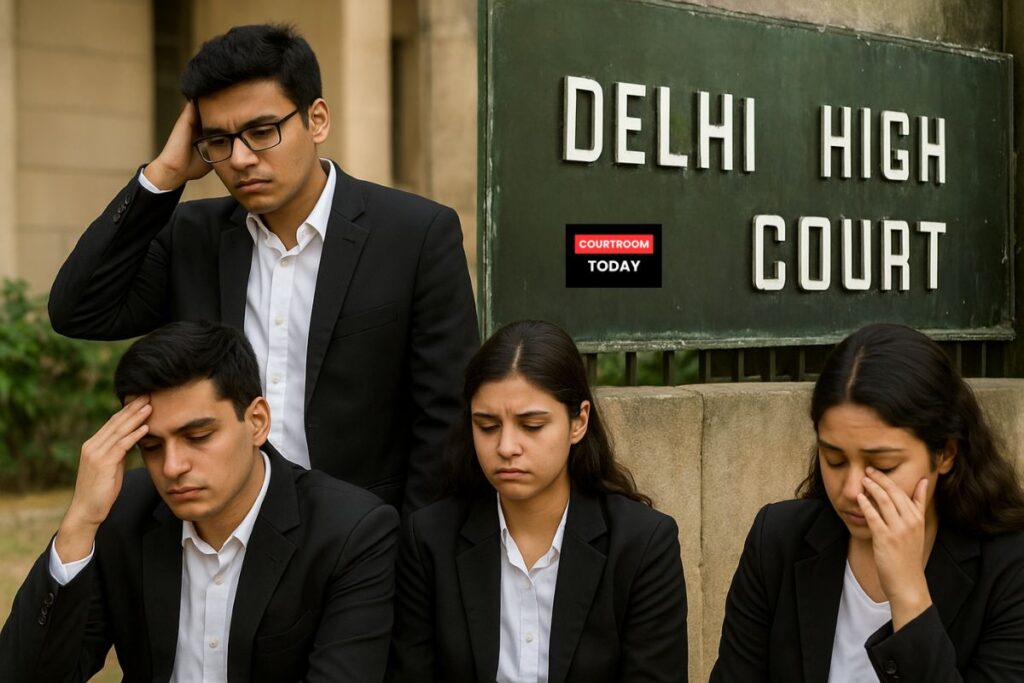
The Delhi High Court has ruled that law students cannot be stopped from appearing in semester examinations or from being promoted to the next semester because of attendance shortages.
The Division Bench of Justice Prathiba M Singh and Justice Amit Sharma issued a set of detailed directions on legal education in India while hearing a suo motu case, Courts on its own motion in re: Suicide Committed by Sushant Rohilla, Law Student of IP University.
The Court said that no law college can impose attendance requirements beyond what is prescribed by the Bar Council of India (BCI). If a student fails to meet attendance norms, the institution may only deduct a limited percentage of marks — up to 5% in the marks-based system or 0.33% in the CGPA system.
A detailed copy of the judgment will be made available soon.
Attendance communication and extra classes
The Bench directed that colleges must regularly inform students and their parents about attendance records. If a student falls short, the college must provide extra physical or online classes to help them make up the deficit.
Grievance Redressal Commissions in colleges
It further ordered that all law colleges, universities, and educational institutions must form Grievance Redressal Commissions (GRCs). The University Grants Commission (UGC) has been asked to amend its regulations so that 51% of the members of every GRC are students.
“There must be full-time representation of students,” the Court said.
Student mental health and counselling
The Court also directed the BCI to amend its affiliation conditions to ensure that each law college has a sufficient number of counsellors and psychiatrists to assist students facing mental health issues.
Review of attendance and internship opportunities
The BCI has also been told to re-evaluate the rule of mandatory attendance for three-year and five-year law courses, and to give credit for participation in moot courts.
Additionally, the BCI should maintain and publish a list of senior advocates, law firms, and organisations offering internships, so that opportunities are accessible to students, especially those from underprivileged backgrounds.
Background of the case
These directions stem from a Public Interest Litigation (PIL) initiated by the Court after the 2017 suicide of Sushant Rohilla, a law student at Amity University. Reports suggested that Rohilla had been harassed for low attendance and was forced to repeat a year, which allegedly pushed him to take his life.
While closing the case, the Court appreciated the efforts of Senior Advocate Dayan Krishnan, who served as amicus curiae, and praised Rohilla’s family for their strength and persistence in seeking justice.
“They have exhibited enormous resilience and deserve credit for fighting the cause,” the Bench noted.
——————————————–
Have a case update, article, or deal to share? Courtroom Today welcomes contributions from lawyers, law firms, and legal professionals. Write to contact@courtroomtoday.com