
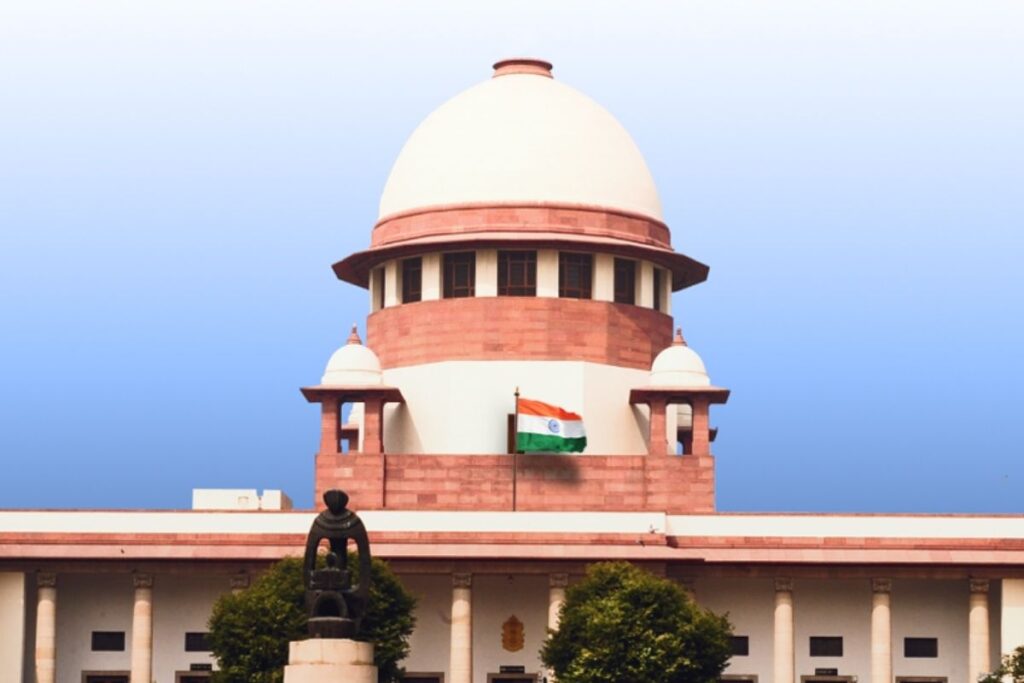
The Supreme Court has referred to a three-judge bench the issue of whether High Courts can directly hear anticipatory bail pleas without applicants first approaching sessions courts.
A bench of Justices Vikram Nath and Sandeep Mehta took this decision while hearing an application filed by the Kerala High Court Advocates’ Association (KHCAA), which sought to intervene in the matter.
Earlier, the Supreme Court had expressed concern over the “regular practice” of the Kerala High Court entertaining anticipatory bail petitions directly, noting that this does not occur in other states. The top court had appointed Senior Advocate Sidharth Luthra as amicus curiae (friend of the court) to assist in the case.
Luthra agreed with the Court’s observation, stating that although High Courts and Sessions Courts have concurrent powers to grant anticipatory bail, it is preferable for applicants to approach Sessions Courts first. This, he said, would help ensure smoother access to justice and better judicial efficiency.
He, however, cautioned against removing the concurrent jurisdiction provided under Section 482 of the Bharatiya Nagarik Suraksha Sanhita (BNSS), which corresponds to Section 438 of the old Code of Criminal Procedure (CrPC).
Following this, 165 lawyers from Kerala passed a resolution urging KHCAA to represent their stand before the Supreme Court. In response, KHCAA filed an application asserting that both the High Courts and Sessions Courts enjoy equal authority to entertain anticipatory bail pleas, and that the law does not require applicants to approach Sessions Courts first.
The Association highlighted that both Section 438 of the CrPC and Section 482 of the BNSS use the word “or”, thereby granting the applicant the freedom to choose either court. They argued that if the legislature wanted to impose such a restriction, it would have done so explicitly.
KHCAA also cited a 2003 judgment of the Kerala High Court in Balan v. State of Kerala, which clarified that there is no mandatory requirement to approach the Sessions Court first. Based on this ruling, several benches of the Kerala High Court have continued to hear anticipatory bail petitions directly.
However, since the current case is under consideration by the Supreme Court, different benches of the Kerala High Court have adopted varying interpretations.
The KHCAA also informed the apex court that Kerala’s online case management system allows the High Court to quickly access records from lower courts, ensuring no delay or procedural difficulty in hearing anticipatory bail pleas directly.
Senior Advocates V Giri and S Nagamuthu, along with Advocate A Karthik, appeared on behalf of KHCAA before the bench of Justices Nath and Mehta. The bench has now referred the issue to a larger three-judge bench for further consideration.
——————————————–
Have a case update, article, or deal to share? Courtroom Today welcomes contributions from lawyers, law firms, and legal professionals. Write to contact@courtroomtoday.com