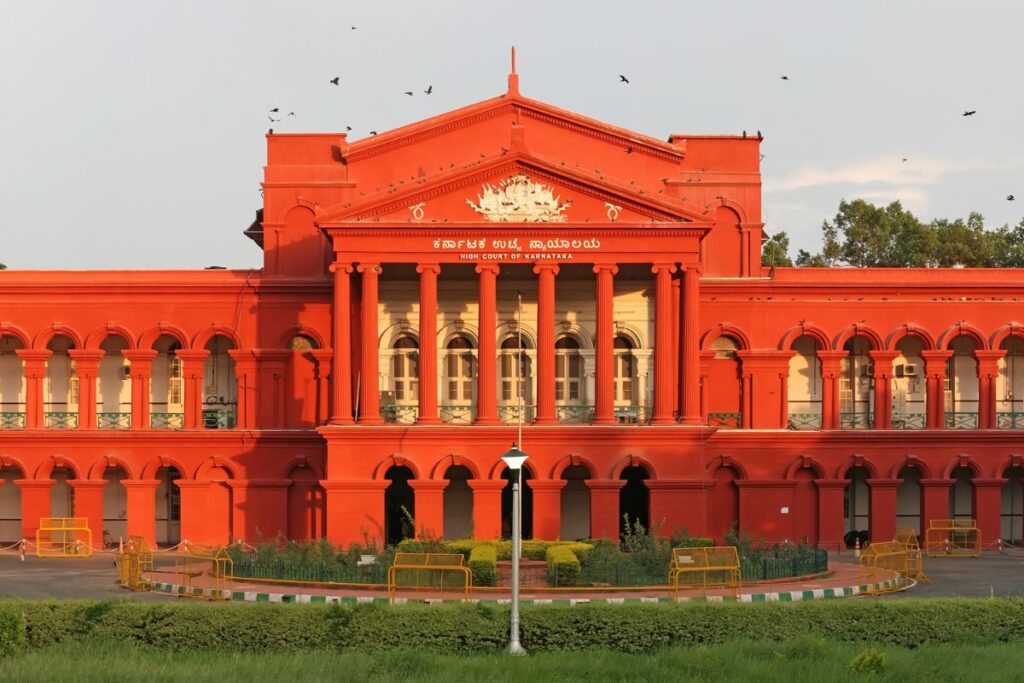
The Karnataka High Court has ruled that the Central government, not the State, is the “appropriate government” to regulate the service conditions of employees of the Bengaluru Metro Rail Corporation Limited (BMRCL).
Justice Anant Ramanath Hegde delivered the verdict while hearing six connected petitions filed by the BMRCL Employees’ Union and BMRCL itself. The Court clarified that the Metro operates under the Central government’s authority and struck down the BMRCL Employees (Conduct, Discipline and Appeal) Rules, 2014, along with two State notifications declaring metro services as public utility and essential services under the Industrial Disputes Act, 1947 and the Karnataka Essential Services Maintenance Act, 2013.
The Court observed that the Central government exercises pervasive control over BMRCL and that the metro qualifies as a “railway company” under Section 2(o) of the Industrial Disputes Act, 1947 read with Section 3(5) of the Indian Railways Act, 1890.
How the Dispute Began
The BMRCL Employees’ Union had challenged the State’s authority to frame service rules and notifications concerning metro employees. It argued that since the metro falls under Central laws like the Metro Railways (Construction of Works) Act, 1978 and the Metro Railways (Operation and Maintenance) Act, 2002, only the Centre can regulate such matters. The Union also opposed the State’s 2017 and 2019 notifications that declared metro services as essential and public utility services, claiming they were unconstitutional.
Court’s Observations
Justice Hegde undertook a detailed analysis of the metro-related Central Acts and the 2010 Memorandum of Understanding (MoU) between the Centre and the Karnataka government. The Court highlighted that:
- The Central government appoints top officials, including the General Manager, and controls operations, safety, and approvals for new metro lines.
- The MoU prevents the State from transferring the Managing Director without the Central government’s consent.
- No metro service can begin without the Centre’s prior sanction.
Based on this, the Court concluded that BMRCL fits the legal definition of a “railway company,” as it operates and maintains a railway system under an agreement with the government.
Outcome of the Case
The Court quashed both State notifications for being issued without proper jurisdiction, ruling that:
- The Karnataka Essential Services Maintenance Act, 2013 does not apply to railway transport.
- The Industrial Disputes Act’s First Schedule excludes railways from the category of transport services.
However, the Court dismissed BMRCL’s petitions challenging certain Central government orders, including the recognition of 12 union office bearers as protected workmen, holding that these were validly issued by the competent authority.
Counsel appearing in the case:
- BMRCL Employees’ Union: Senior Advocate PS Rajagopal, with Advocates Ashwini Rajagopal and Jayanth Dev Kumar
- BMRCL: Advocate Santosh Narayan
- State of Karnataka: Additional Advocate General Santosh Gogi, with Advocate Manjunath B.
- Union of India: Advocate MN Kumar
——————————————–
Have a case update, article, or deal to share? Courtroom Today welcomes contributions from lawyers, law firms, and legal professionals. Write to contact@courtroomtoday.com