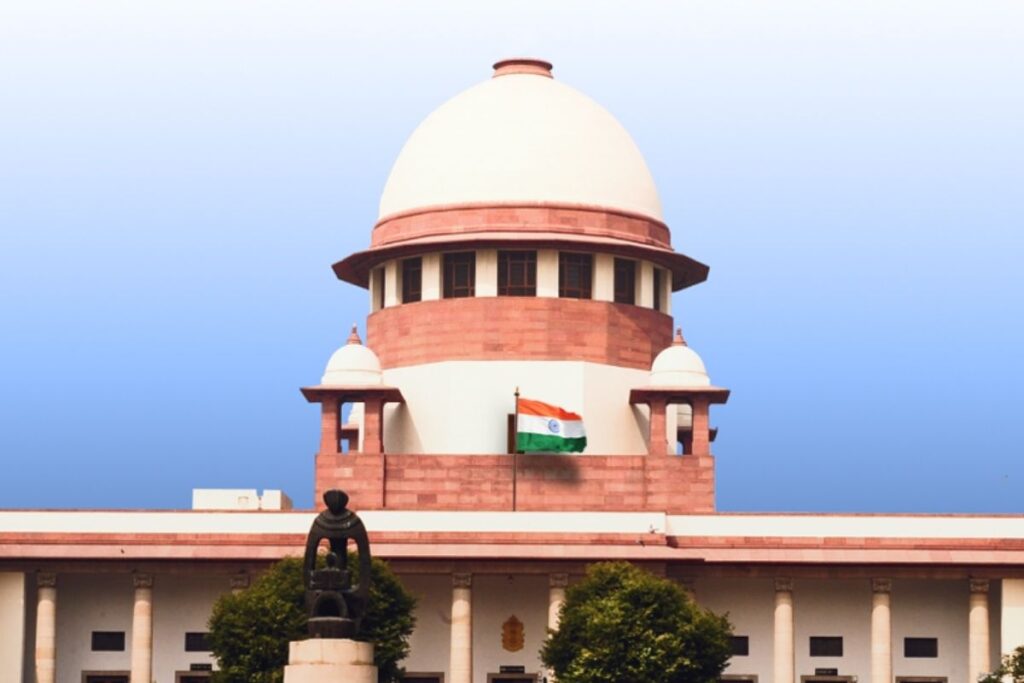
In a rare move focused on supporting a young student’s education, the Supreme Court on Monday allowed the issuance of a Scheduled Caste (SC) certificate to a minor girl based on her mother’s caste, even though her father does not belong to an SC community. This order comes at a time when the Court is still hearing several petitions that challenge the long-standing rule that a child generally inherits the father’s caste.
A Bench of Chief Justice Surya Kant and Justice Joymalya Bagchi refused to interfere with a Madras High Court order directing authorities in Puducherry to grant the girl an SC certificate. The judges said they were doing so only to ensure that the child’s academic journey is not harmed. “We are keeping the question of law open,” the Bench clarified.
However, a remark by the Chief Justice may open a larger national debate. CJI Surya Kant observed, “With changing times, why should a caste certificate not be issued based on the mother’s caste?” If this view is taken forward in the future, it could mean that children of SC mothers married to men from forward or non-SC castes may also become eligible for SC certificates, even if they were raised in an upper-caste household.
The case before the Court involved a mother who sought SC certificates for her three children—two daughters and a son—based on her own ‘Adi Dravida’ caste. She stated that since her marriage, her husband had stayed at her parental home and the children had been raised within her family, which belongs to the Hindu Adi Dravida community.
According to presidential notifications issued in 1964 and 2002, and guidelines from the Ministry of Home Affairs, caste eligibility is primarily determined by the father’s caste and his place of residence within a state or Union Territory.
Supreme Court precedents on father’s caste rule
Earlier, the Supreme Court had held that a person’s caste is generally inherited from the father. In the 2003 ruling Punit Rai v. Dinesh Chaudhary, the Court said that under customary Hindu law, the father’s caste is the decisive factor unless a specific law provides otherwise.
However, in 2012, the Supreme Court adopted a more flexible approach in Rameshbhai Dabhai Naika v. State of Gujarat. A two-judge Bench held that in inter-caste or inter-tribal marriages, the child’s caste cannot be decided mechanically. While the child may be presumed to follow the father’s caste—especially if the father belongs to a forward caste—the presumption is not final.
The Court said the child can prove that they were brought up in the mother’s SC/ST community, faced similar social disadvantages, and were accepted by that community and society as belonging to it. If these conditions are met, the child may be treated as part of the mother’s caste for the purpose of benefits and legal recognition.
——————————————–
Have a case update, article, or deal to share? Courtroom Today welcomes contributions from lawyers, law firms, and legal professionals. Write to contact@courtroomtoday.com