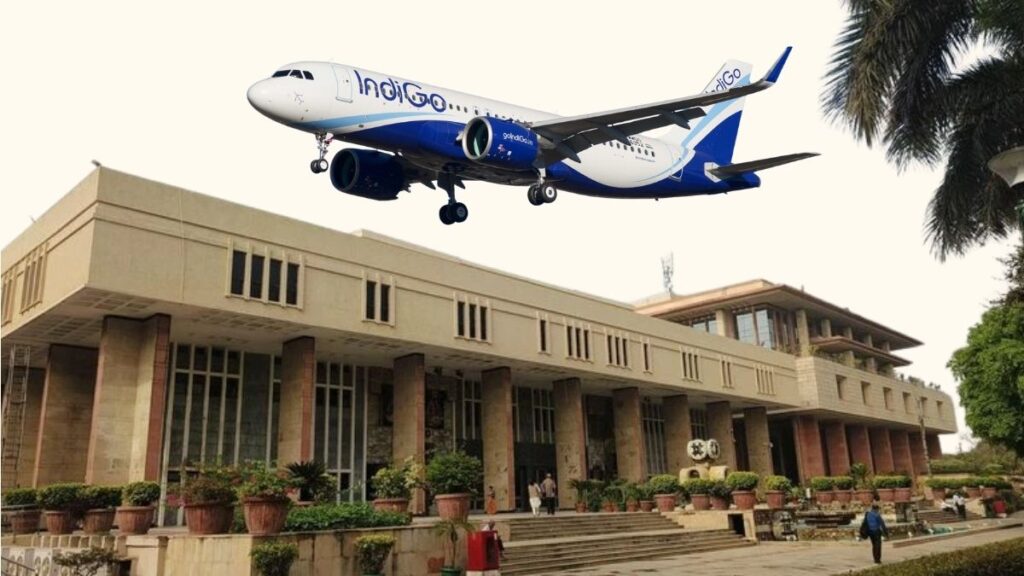
InterGlobe Aviation Ltd, which operates India’s largest airline IndiGo, has approached the Delhi High Court seeking a refund of more than ₹900 crore paid as customs duty on aircraft engines and parts that were re-imported into India after being sent abroad for repairs.
The case was initially heard by a Division Bench of Justice Prathiba M Singh and Justice Shail Jain. However, Justice Shail Jain recused herself from the matter after disclosing that her son is a pilot employed with IndiGo. The case will now be listed before another Bench, subject to directions from the Chief Justice.
IndiGo argued that levying customs duty on re-imported aircraft parts after repairs amounts to double taxation and is unconstitutional. The airline submitted that when aircraft engines and components are sent overseas for repairs and then brought back, the transaction is essentially a service and not a fresh import of goods.
Advocate V Lakshmikumaran, appearing for IndiGo, explained that the airline had already paid basic customs duty at the time of re-import without dispute. Since repair work is treated as a service, IndiGo also paid Goods and Services Tax (GST) under the reverse charge mechanism. Despite this, customs authorities demanded customs duty again by treating the re-import as a fresh import of goods.
IndiGo pointed out that the customs tribunal had earlier ruled that customs duty cannot be imposed again on aircraft parts re-imported after repairs. Although the government later amended the relevant exemption notification, the tribunal held that this amendment would apply only prospectively. The airline also highlighted that the High Court had struck down the portion of the notification that allowed such additional levy, declaring it unconstitutional.
Despite these rulings, customs authorities allegedly forced IndiGo to pay the duty to avoid disruption of operations. The airline argued that aircraft engines and critical parts cannot remain stuck indefinitely as customs clearance requires officer approval. As a result, IndiGo paid the duty under protest across more than 4,000 bills of entry, amounting to over ₹900 crore.
When IndiGo later applied for a refund, the customs department rejected the claims, stating that each bill of entry must first be reassessed. The airline argued that it had clearly paid the duty under protest in every case and that speaking orders had already been issued, which were challenged through appeals.
IndiGo further contended that the department’s reliance on the Supreme Court’s decision in ITC Ltd. was incorrect. According to the airline, that judgment applies to cases where duty was voluntarily paid, not where payment was made under protest and courts had already ruled in favour of the taxpayer.
The airline also informed the Court that despite repeated representations to senior officials, including the Principal Commissioner, no reassessment orders were passed. IndiGo argued that insisting on reassessment even after a declaration of unconstitutionality effectively denies the benefit of the court’s judgment.
In March 2024, the Delhi High Court had ruled that re-import of aircraft and aircraft parts after overseas repairs amounts to an import of services, not goods. The Court held that once GST is levied on such transactions, the government cannot impose an additional customs duty under the Customs Tariff Act. It declared the relevant notification unconstitutional and beyond the scope of the IGST Act.
The matter is currently pending before the Supreme Court.
——————————————–
Have a case update, article, or deal to share? Courtroom Today welcomes contributions from lawyers, law firms, and legal professionals. Write to contact@courtroomtoday.com