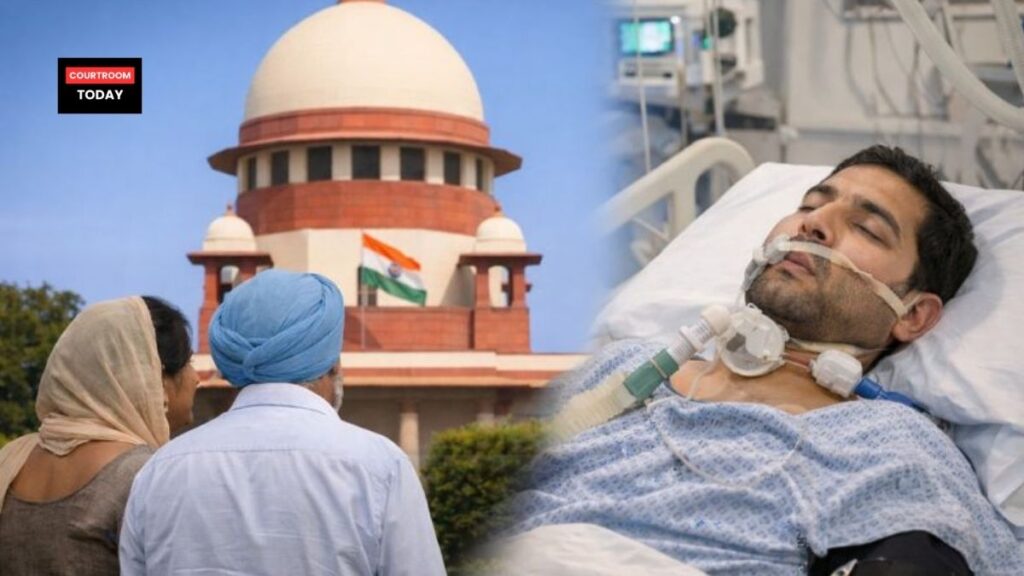
The Supreme Court in Harish Rana v. Union of India said it would personally speak to the parents of a 32-year-old man before taking a final decision on allowing passive euthanasia for him. The man has been in a vegetative state for the past 12 years after falling from a building.
The Court examined a report submitted by the All India Institute of Medical Sciences (AIIMS), which assessed the man’s medical condition. After going through the report, the Bench observed that the situation was “very sad” and noted that the chances of recovery were extremely low.
A Bench of Justice JB Pardiwala and Justice KV Viswanathan is hearing an application filed by the man’s father, seeking permission to withdraw life-sustaining treatment. As per the Supreme Court’s 2018 Constitution Bench judgment in Common Cause, later modified in 2023, passive euthanasia can be allowed only after opinions from both Primary and Secondary Medical Boards.
Earlier, a Primary Medical Board had reported that recovery was negligible. It noted that the man is bedridden, dependent on a tracheostomy tube for breathing and a gastrostomy tube for feeding, and has developed severe bed sores. Following this, the Supreme Court directed AIIMS to constitute a Secondary Medical Board.
On December 18, Additional Solicitor General Aishwarya Bhati informed the Court that the AIIMS report had been submitted. Justice Pardiwala, while referring to the report, remarked that it would be difficult to continue life in such a condition indefinitely.
Since the report had not yet been shared with the counsels, the Court directed the Registry to provide copies to Advocate Rashmi Nandakumar, appearing for the petitioner, and to ASG Bhati. The Court asked both counsels to carefully study the report and assist in arriving at a final decision.
ASG Bhati submitted that it would be appropriate to consult the family before passing any order. Agreeing with this, the Court said it wished to meet the parents in person, observing that such a sensitive issue could not be addressed through virtual interaction. The parents have been directed to remain present before the Court on January 13, 2026.
The Court also asked the counsels to speak with the family and submit their written submissions. It clarified that a final decision would be taken only after considering the medical reports and the views of the parents.
The father had earlier approached the Supreme Court in 2024 seeking passive euthanasia, which was not allowed at that time. However, the State of Uttar Pradesh had then agreed to bear the cost of medical treatment. The father later moved a fresh application stating that his son’s condition had further deteriorated and that he was no longer responding to treatment.
——————————————–
Have a case update, article, or deal to share? Courtroom Today welcomes contributions from lawyers, law firms, and legal professionals. Write to contact@courtroomtoday.com