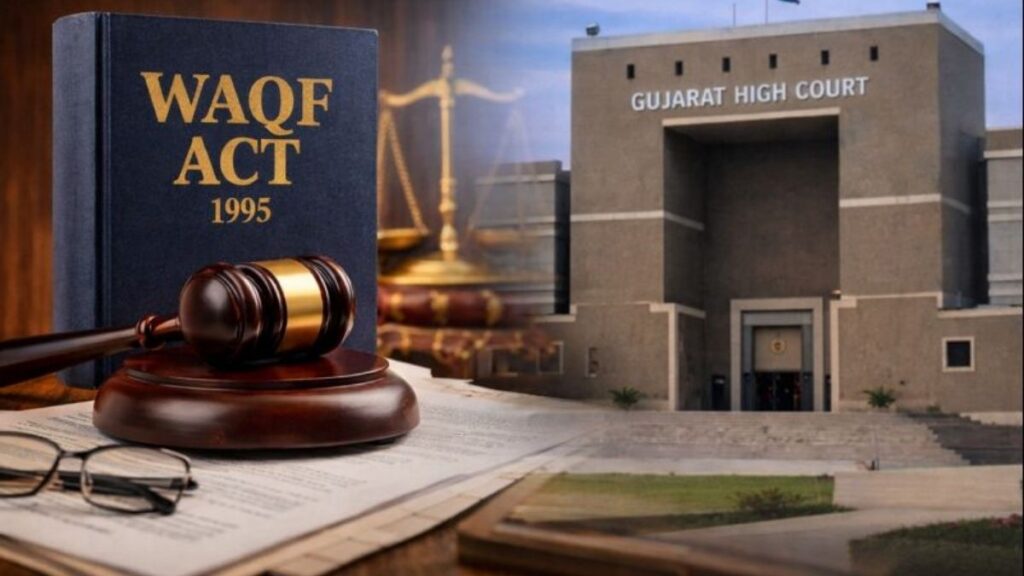
The Gujarat High Court has ruled that payment of court fees is compulsory for cases filed before the Gujarat State Waqf Tribunal relating to Waqf properties. The Court clarified that applications filed under Chapter VIII of the Waqf Act, 1995 are governed by the Code of Civil Procedure (CPC) and the Gujarat Court Fees Act, 2004.
The issue arose from arguments that court fees should not apply because Section 83(3) of the Waqf Act refers to proceedings as an “application” and not a “suit.” It was contended that this distinction exempts such cases from court fee requirements. However, Justice JC Doshi rejected this argument.
The Court observed that applications filed before the Waqf Tribunal are adversarial in nature. These cases involve disputes between landlords and tenants, claims for eviction, and determination of rights and obligations of the parties. Since such proceedings closely resemble civil suits in substance and procedure, merely calling them “applications” does not change their true legal character.
Justice Doshi pointed out that the Waqf Tribunal is statutorily deemed to be a Civil Court and is vested with all powers of a Civil Court under the CPC. Therefore, proceedings before the Tribunal must follow civil law principles, including payment of appropriate court fees.
The Court held that there is no blanket exemption under the Waqf Act from paying court fees in Gujarat. In the absence of a specific statutory exemption, applications filed under Section 83 of the Act attract court fees as prescribed under the Gujarat Court Fees Act.
The High Court also ruled that provisions of the CPC apply fully to Waqf Tribunal proceedings. As a result, applications can be rejected under Order VII Rule 11 of the CPC for reasons such as improper valuation or non-payment of required court fees.
The judgment was delivered in a batch of 133 petitions involving recovery of possession of Waqf properties from tenants or alleged encroachers. The Waqf Tribunal had earlier rejected these applications because the cases were undervalued and the required court fees were not paid.
Despite being given an opportunity to correct the valuation and pay the deficit court fees, the applicants failed to comply. Consequently, their applications were rejected. The High Court refused to interfere with these orders, noting that the initial direction to correct valuation was never challenged in time.
The Court held that once the first order directing correction of valuation was not challenged, the subsequent rejection of the plaint could not be questioned on the ground of insufficient court fees. Finding no legal error or jurisdictional defect, the High Court dismissed the petitions.
Advocate MTM Hakim appeared for the petitioners, while Government Pleader Gursharan Virk represented the State. Advocate Manish Shah appeared on behalf of the Gujarat State Waqf Board.
——————————————–
Have a case update, article, or deal to share? Courtroom Today welcomes contributions from lawyers, law firms, and legal professionals. Write to contact@courtroomtoday.com