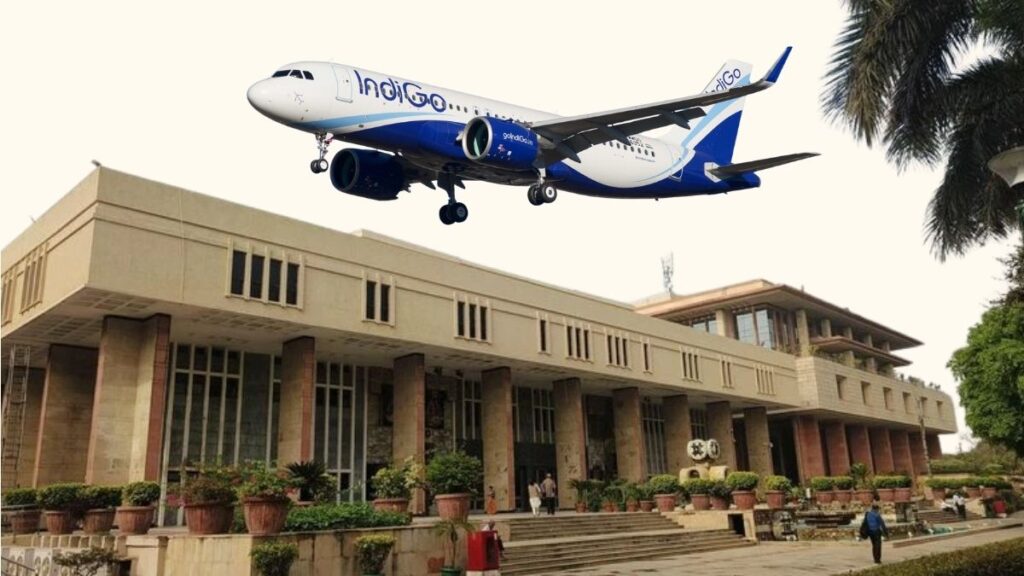
The Delhi High Court has asked the Customs Department to file its reply on a petition filed by IndiGo Airlines, which is seeking refunds of over ₹900 crore. The dispute relates to customs duty charged on aircraft engines and parts that were sent abroad for repair and later brought back into India.
A Division Bench of Justice V. Kameswar Rao and Justice Vinod Kumar issued the notice and listed the matter for further hearing in April 2026.
What is the dispute about?
IndiGo, operated by InterGlobe Aviation Ltd., had temporarily exported aircraft engines and components for repairs outside India. When these parts were brought back:
- IndiGo paid basic customs duty at the time of re-import
- Since repairs are treated as a service, GST was also paid under the reverse charge mechanism
However, customs authorities treated the re-import as a fresh import of goods and levied customs duty again. IndiGo has argued that this resulted in double taxation for the same transaction.
Tribunal’s earlier rulings
IndiGo told the High Court that the issue had already been decided in its favour by the Customs, Excise and Service Tax Appellate Tribunal (CESTAT). The tribunal had held that:
- Customs duty cannot be charged again on goods re-imported after repair
- Amendments to exemption notifications would apply only prospectively
- Later, CESTAT also declared the levy of customs duty on repaired re-imported goods as unconstitutional
Despite these rulings, the airline claimed that customs authorities continued to demand duty.
Why did IndiGo pay the duty?
IndiGo submitted that aircraft engines and key parts cannot be kept pending clearance, as this would disrupt flight operations. Unlike GST, customs clearance depends on officer approval. As a result:
- IndiGo paid the disputed duty under protest
- Payments were made across more than 4,000 bills of entry
- The total amount paid exceeded ₹900 crore
When the airline later applied for refunds, the Customs Department rejected the claims. The department stated that IndiGo must first seek reassessment of each bill of entry.
IndiGo’s argument on refunds
IndiGo argued that:
- All payments were made under protest
- Speaking orders had already been passed on the protested assessments
- Appeals against those orders were already pending
The airline said that insisting on reassessment creates an unreasonable procedural hurdle, especially when the levy itself has been declared unconstitutional.
Customs authorities relied on the Supreme Court judgment in ITC Ltd. v. Commissioner of Central Excise, which held that reassessment is necessary before claiming a refund. IndiGo countered this by stating that:
- The ITC judgment applied to voluntary payments
- Its case involved payments made under protest
- The duty itself has been held unconstitutional
IndiGo further submitted that despite repeated representations, including to senior customs officials, no reassessment orders have been passed. The airline argued that forcing reassessment even after a declaration of unconstitutionality effectively denies the benefit of earlier judicial decisions.
——————————————–
Have a case update, article, or deal to share? Courtroom Today welcomes contributions from lawyers, law firms, and legal professionals. Write to contact@courtroomtoday.com