
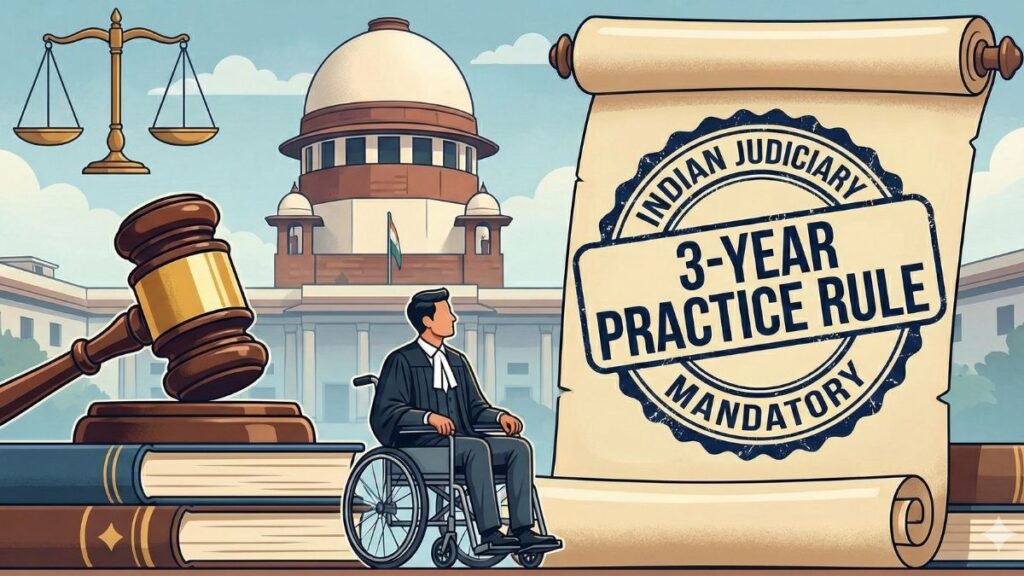
The Supreme Court of India has asked High Courts and National Law Universities (NLUs) to share their views on whether the requirement of three years of legal practice for joining judicial services should be relaxed for persons with disabilities.
The issue arises from a plea filed in Bhumika Trust v. Union of India & Ors, which challenges the Supreme Court’s earlier ruling that made three years of practice mandatory before entering judicial service. The petition argues that this condition may unfairly affect candidates with disabilities.
A Bench led by Chief Justice of India Surya Kant, along with Justices Joymalya Bagchi and Vijay Bishnoi, observed that the opinions of all stakeholders must be considered before taking a final call. The Court has given High Courts and NLUs four weeks to submit their suggestions.
The Court clarified that the three-year practice period can be counted from the date a law graduate begins practice on provisional enrolment, and not from the date of clearing the All India Bar Examination (AIBE). It also held that experience gained as a law clerk to a judge can be counted as legal practice.
Further, the Court explained how legal practice must be certified. If the candidate has practised in district courts, certification can be given by the principal judicial officer or a senior advocate with ten years’ standing. For those practising in High Courts or the Supreme Court, certification must come from a senior advocate endorsed by an authorised court officer.
The Bench noted that appointing judges without sufficient courtroom experience has earlier led to practical difficulties. It reiterated that prior legal practice helps judicial officers handle complex cases more effectively.
While supporters of the rule argue that courtroom experience improves judicial quality, critics say the requirement creates unnecessary barriers for young and disabled law graduates. The Court will examine these concerns after receiving responses from the stakeholders.
——————————————–
Have a case update, article, or deal to share? Courtroom Today welcomes contributions from lawyers, law firms, and legal professionals. Write to contact@courtroomtoday.com