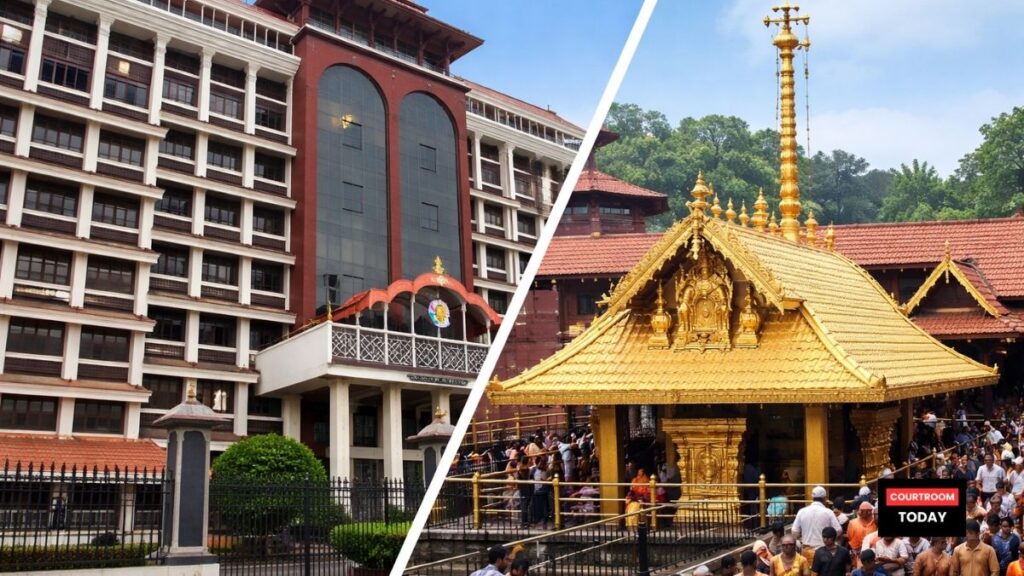
The Kerala High Court has issued detailed guidelines to strengthen vigilance oversight at the Sabarimala Temple and other temples managed by the Travancore Devaswom Board. The Court said that timely reporting and swift action are necessary to prevent corruption, administrative lapses, and mismanagement in temple administration.
The directions were issued by a Division Bench of Justice Raja Vijayaraghavan V and Justice K V Jayakumar, while closing a suo motu case concerning the reporting of misconduct, unauthorised absence of temple staff, and other irregularities in Devaswom temples.
Why the Court intervened
The case arose from reports submitted by the Sabarimala Special Commissioner, which highlighted shortcomings in how vigilance-related issues were being reported to the Board. The Court noted that if instances of misconduct are not promptly brought to the notice of the Devaswom Board, effective corrective action becomes difficult.
The Bench observed that a lack of real-time reporting could allow corruption and mismanagement to continue unchecked, defeating the purpose of vigilance mechanisms.
Concerns raised during the hearing
The Travancore Devaswom Board informed the Court that vigilance reports were being submitted directly to the Board for action, as per earlier modified directions. However, the amicus curiae assisting the Court pointed out two major concerns.
First, if reports are sent only to the Board, the Sabarimala Special Commissioner may not receive immediate information about ongoing irregularities. Second, combining reports relating to Sabarimala and other temples into a single document could make it difficult to identify issues specific to Sabarimala, especially during the busy pilgrimage season.
Taking note of these concerns, the Court decided to restructure the reporting mechanism.
Key directions issued by the Court
Quarterly vigilance reports
The vigilance wing of the Travancore Devaswom Board must now submit detailed status reports every quarter. These reports must cover January–March, April–June, July–September, and October–December, and be submitted within seven days from the end of each quarter. Copies must also be sent to the Sabarimala Special Commissioner on fixed dates each year.
Separate reporting for Sabarimala
The Court directed that vigilance reports should be divided. Issues relating specifically to the Sabarimala Temple must be reported separately from those concerning other temples under the Board’s control. This, the Court said, would help in quicker identification and resolution of problems.
Time-bound disciplinary action
The Devaswom Board has been instructed to examine each vigilance report within one month and initiate disciplinary proceedings wherever required. Action taken reports must be promptly forwarded to the Special Commissioner, who will place them before the Court.
Enhanced vigilance during pilgrimage season
Special focus has been ordered at the Sabarimala Temple during the Mandala–Makaravilakku pilgrimage season, from November 15 to January 15, and during the first five days of each Malayalam month when the temple is open. When Sabarimala is closed, vigilance efforts should shift to other major temples managed by the Board.
Powers of the Special Commissioner preserved
The Court clarified that these guidelines do not limit the authority of the Sabarimala Special Commissioner. The Commissioner remains free to report any serious issue at any time, even outside the periodic reporting schedule.
Standing counsel G Biju appeared for the Travancore Devaswom Board, while Sayujya Radhakrishnan assisted the Court as amicus curiae.
——————————————–
Have a case update, article, or deal to share? Courtroom Today welcomes contributions from lawyers, law firms, and legal professionals. Write to contact@courtroomtoday.com