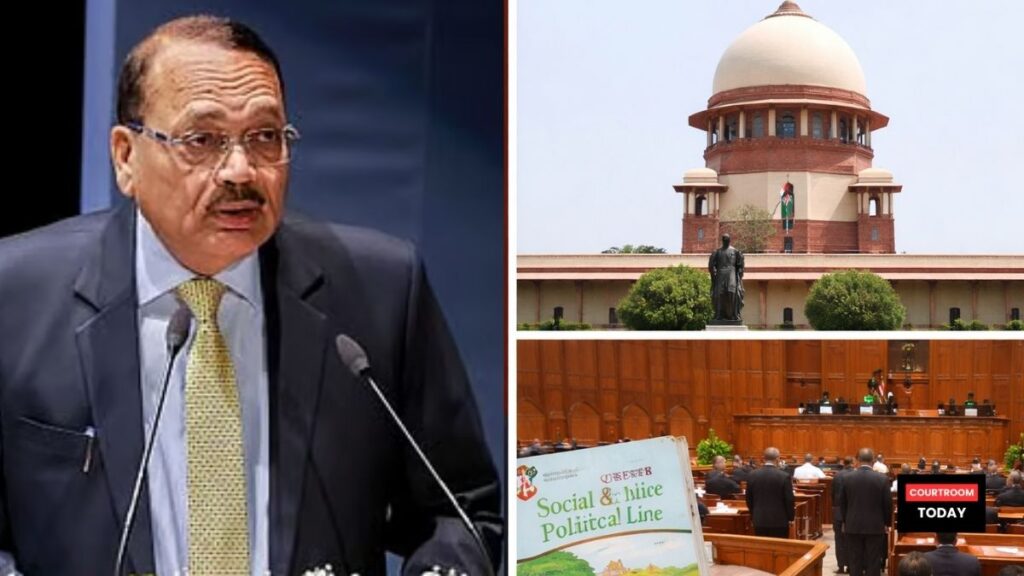
Chief Justice of India Surya Kant has taken strong exception to content in a new Class 8 social science textbook issued by NCERT that refers to “corruption in judiciary.” The issue was raised before the Supreme Court of India on Wednesday.
The controversy began after a report by The Indian Express highlighted that the revised textbook mentions “corruption in judiciary” and “massive backlogs” as key challenges faced by the system. The references reportedly triggered concern among members of the legal community.
Senior Advocate Kapil Sibal, along with Senior Advocate Abhishek Manu Singhvi, mentioned the matter before the Chief Justice. Sibal expressed deep concern about children being introduced to such themes at the school level.
“We are deeply disturbed as the members of this institution to find that children of Class 8 students are being taught about corruption in judiciary. It is part of the NCERT. We have great stake in the institution; it is entirely scandalous. We have the copies of the book,” Sibal said in court.
Responding to the concerns, the Chief Justice made it clear that the issue was already under consideration. He stated that he had received several calls and messages regarding the contents of the book and that members of the judiciary were uneasy.
“I can assure all of you. I am fully aware of it,” the CJI said. He added that many High Court judges were “perturbed” by what had been published. According to him, the matter affected the institution as a whole.
When Sibal suggested that the Court may take suo motu notice, the Chief Justice confirmed that action had already been initiated. “Wait for a day. This is definitely concerning the entire institution. The bar and the bench are perturbed… I have already passed an order and am taking the matter suo motu.”
He further stated, “I will not allow anyone on earth to taint the integrity of the institution and defame the institution. At any cost, I will not permit it. Whosoever high it may be, the law will take its course. I know how to deal with it.”
Singhvi also pointed out that the concern was not limited to the content itself but extended to what he described as selective focus. He noted the absence of references to corruption in other public institutions.
Justice Bagchi also observed that “Constitutional integrity to the basic structure is missing in the structure of the book.” The Court is now expected to examine the matter further under its suo motu powers.
——————————————–
Have a case update, article, or deal to share? Courtroom Today welcomes contributions from lawyers, law firms, and legal professionals. Write to contact@courtroomtoday.com