
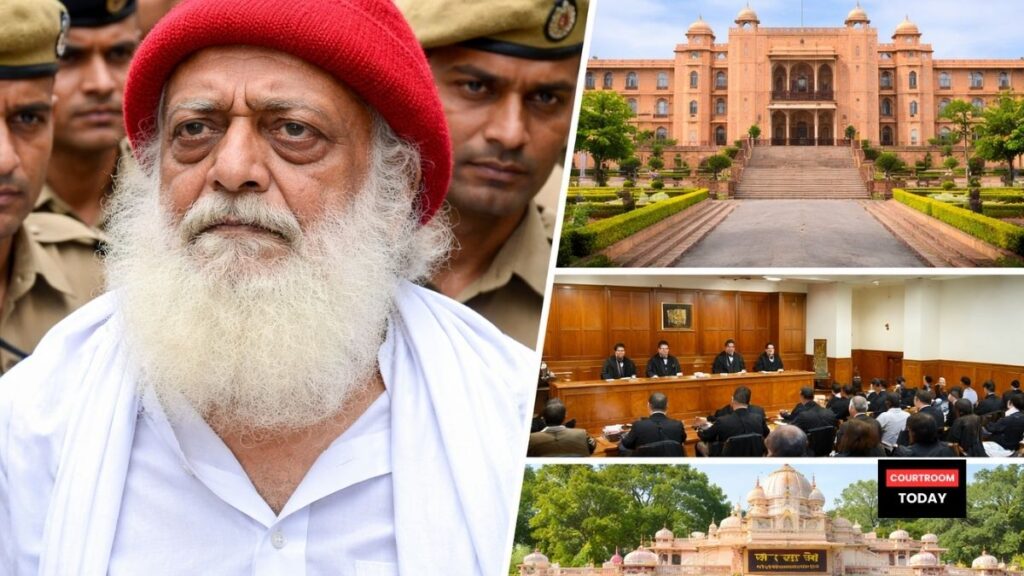
In the appeal arising from the conviction of self-styled godman Asaram, the defence told the Rajasthan High Court that the case against him was fabricated and unsupported by reliable evidence. The matter was heard by a Division Bench examining challenges to his conviction in a rape case.
Senior counsel for Asaram argued that the prosecution’s case was built on contradictions and exaggerated claims. The focus of the defence remained on the testimonies of the prosecutrix’s parents, which were described as inconsistent and unreliable.
The Bench, comprising Justices Arun Monga and Yogendra Kumar Purohit, questioned certain broad submissions made by the defence. When the Court observed that some arguments appeared “omnibus” in nature, counsel insisted that the record showed multiple possible versions of events at every stage.
A key argument revolved around the alleged involvement of Shiva, said to be a close aide of Asaram. The prosecution claimed that the parents had repeatedly contacted Shiva for help. However, the defence relied on call detail records to submit that there were “zero outgoing calls” to him.
“If they say they repeatedly called him, why do the records show none?” counsel asked. It was further pointed out that Shiva had been acquitted by the trial court due to lack of material linking him to the offence.
The defence argued that naming Shiva was an attempt to artificially connect Asaram to the alleged incident. According to counsel, once co-accused persons were acquitted, the theory of conspiracy weakened considerably.
“I cannot conspire with myself,” counsel remarked while challenging the prosecution’s case of criminal conspiracy. He submitted that selectively maintaining conviction against one accused while others were acquitted was legally unsustainable.
The defence also questioned the allegation under Section 370 of the Indian Penal Code. It was argued that the essential ingredients of trafficking were absent, as there was no unlawful transportation or concealment. The family, counsel said, had travelled voluntarily.
On the issue of sexual assault, the defence termed the narrative improbable. It was argued that the appellant did not meet girls privately and that the story of “ghost possession” was created to explain the alleged contact.
Counsel further submitted, “Suspicion, however strong, cannot replace proof.” He also claimed that certain material witnesses were not examined and relevant call records were not produced despite directions.
The Bench repeatedly cautioned against reading isolated portions of testimony without context. It observed that a final assessment would depend on whether the inconsistencies were material or minor.
The appeal remains part heard and has been listed for further hearing at a later date.
——————————————–
Have a case update, article, or deal to share? Courtroom Today welcomes contributions from lawyers, law firms, and legal professionals. Write to contact@courtroomtoday.com