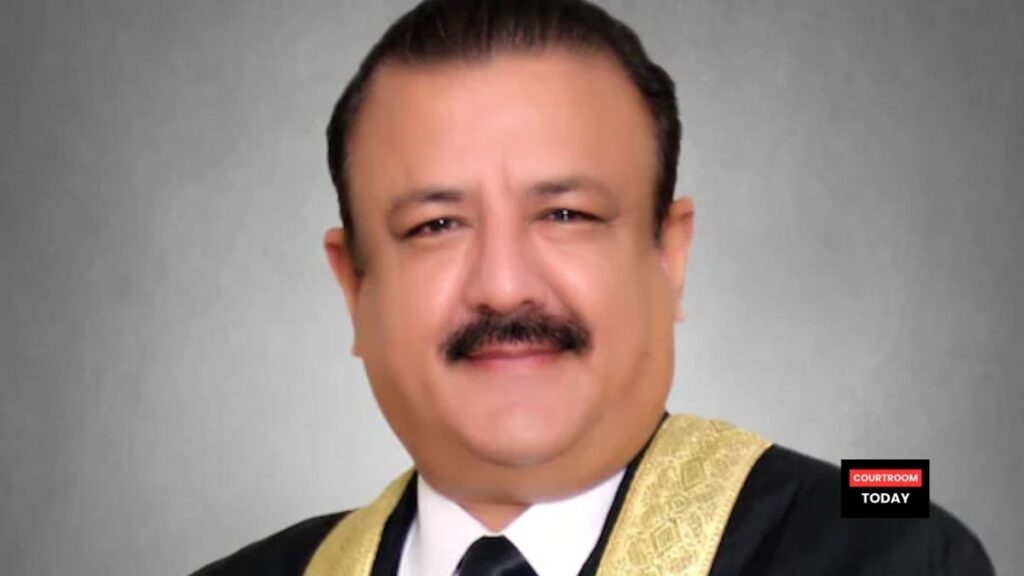
In a major development, the Islamabad High Court has removed Justice Tariq Mahmood Jahangiri from office after declaring his law degree void ab initio. The 116-page judgement, delivered on February 23, held that his appointment as a judge was legally invalid from the very beginning.
Justice Tariq Mahmood Jahangiri had been appointed to the High Court in December 2020. However, he was stopped from performing judicial duties in September last year after serious questions were raised about his academic credentials. For nearly five years, he continued to function as a judge.
The case centred on whether he possessed a valid law degree. The High Court examined original university records obtained from the Registrar of Karachi University. After reviewing the material, the bench concluded that his educational documents were fraudulent and involved impersonation.
According to the court, Jahangiri first appeared for his law examination in 1988 using a fake enrolment number. During that attempt, he was caught cheating. In 1989, the university imposed a three-year ban on him from appearing in examinations.
Instead of accepting the punishment, the judgement records that he adopted dishonest means. The following year, he appeared again for the examination under the name “Tariq Jahangiri.” He allegedly used an enrolment number that actually belonged to another student, Imtiaz Ahmed.
The court also relied on a statement from the principal of Government Islamia Law College. The principal informed the bench that Jahangiri “was never admitted” to the institution. This further weakened his claim of holding a legitimate law qualification.
Despite being granted several opportunities, Jahangiri failed to submit original academic documents before the court. He was also asked to file a written response explaining the discrepancies. However, no satisfactory material was produced to establish the authenticity of his degree.
Instead, he filed applications seeking the constitution of a full bench and requested the recusal of the Chief Justice. He also sought an indefinite adjournment, citing proceedings pending before the Sindh High Court.
The bench described these moves as “dilatory tactics.” It observed that once the petitioner had placed evidence on record challenging the degree, the burden shifted to the respondent to prove his qualifications. His failure to do so led the court to draw an adverse inference.
In its detailed judgement, the Islamabad High Court made it clear that eligibility for judicial office cannot rest on fraudulent credentials. Since the foundation of his legal qualification was void from the beginning, his elevation to the High Court stood vitiated.
The decision raises serious concerns about scrutiny in judicial appointments. It also underlines that integrity in legal education and professional qualifications remains central to maintaining public confidence in the justice system.
——————————————–
Have a case update, article, or deal to share? Courtroom Today welcomes contributions from lawyers, law firms, and legal professionals. Write to contact@courtroomtoday.com