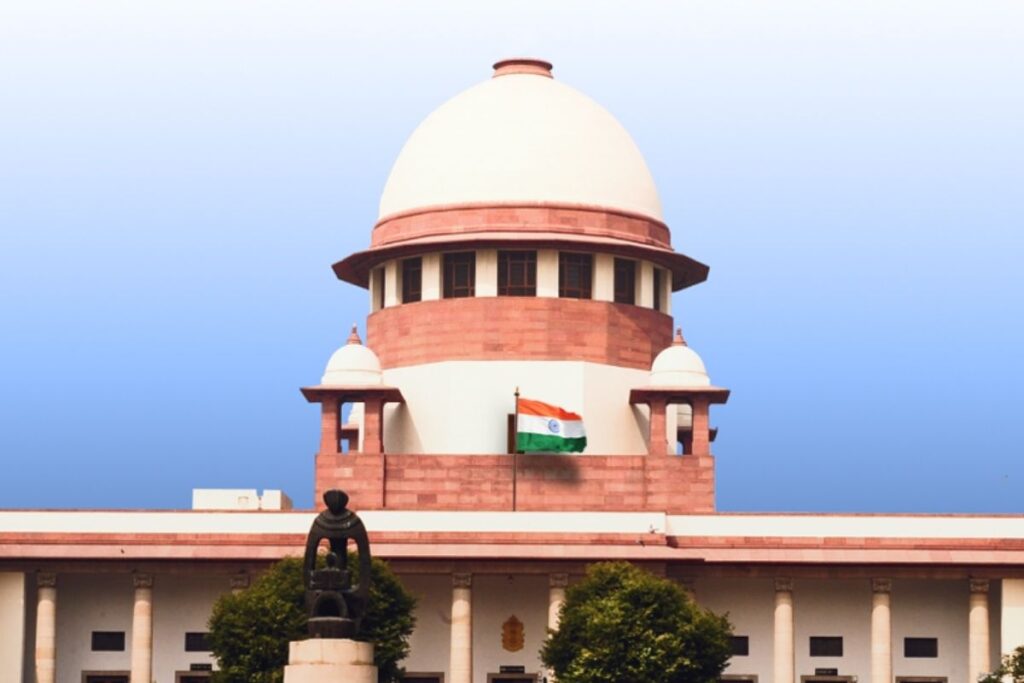

The Supreme Court has sought a response from the Central government on a Public Interest Litigation challenging the practice of animal sacrifice in temples. The plea argues that the killing of animals during religious rituals violates constitutional principles protecting the right to life.
The matter was heard by a Bench of Justices Vikram Nath and Sandeep Mehta, which issued notice to the Ministry of Fisheries, Animal Husbandry and Dairying and directed the authorities to file their response within four weeks.
The PIL has been filed by Advocate Shruti Bisht, who has requested the Court to prohibit animal sacrifice carried out in the name of religious traditions. The petition claims that despite legal safeguards against cruelty to animals, effective steps have not been taken to address the continued practice in several parts of the country.
According to the petition, the Constitution’s Article 21, which guarantees the right to life, should not be interpreted as protecting only human life. It argues that the concept of life under constitutional jurisprudence should extend to animals as well, and therefore practices involving the ritual killing of animals deserve greater scrutiny.
The plea also relies on earlier observations of the Supreme Court recognising that animals are entitled to certain protections under the law. It submits that the State has a duty to ensure that animals are not subjected to unnecessary suffering, even when such acts are justified in the name of faith or cultural customs.
A central aspect of the petition challenges Section 28 of the Prevention of Cruelty to Animals Act, 1960. The provision currently states that killing an animal as part of a religious ritual is not considered an offence under the law. The petitioner has urged the Court to reconsider this exception and direct amendments to the statute.
The plea contends that the exemption effectively allows animal sacrifice to continue without legal consequences. It argues that the provision undermines the broader objective of preventing cruelty to animals and conflicts with evolving standards of animal welfare and constitutional morality.
The petition further notes that animal sacrifice is still practiced in certain regions of India, including parts of the Himalayan belt, northeastern states, Odisha, West Bengal, Maharashtra and some southern states. Similar rituals are also observed in countries such as Nepal and Indonesia’s Bali region.
According to the petitioner, animals selected for sacrifice are typically healthy young male animals. The plea also raises concerns about extreme practices linked to such rituals and stresses the need for stronger legal and social measures to curb them.
In addition to seeking legislative changes, the petition proposes broader policy initiatives. These include awareness campaigns, collaboration with non-governmental organisations and stricter enforcement mechanisms to discourage the practice of animal sacrifice during religious ceremonies.
The Supreme Court will examine the matter further after the Central government submits its response. The case raises important questions about the balance between religious practices and animal welfare protections under Indian law.
——————————————–
Have a case update, article, or deal to share? Courtroom Today welcomes contributions from lawyers, law firms, and legal professionals. Write to contact@courtroomtoday.com