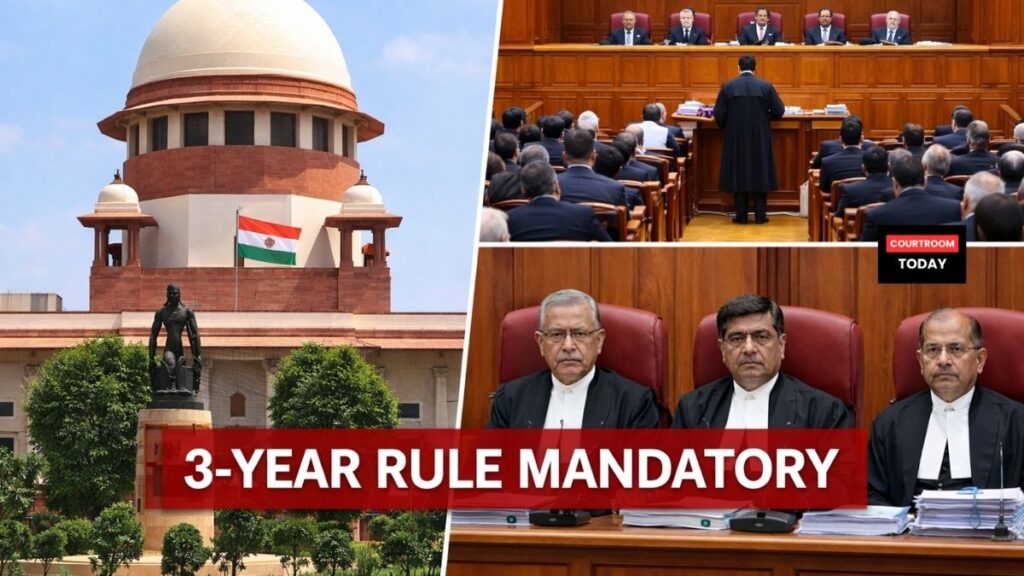
The Supreme Court recently heard review petitions in Bhumika Trust v. Union of India and connected cases, concerning the requirement of three years’ legal practice for entry into the judicial service. During the hearing, the Court made it clear that the practice condition is likely to remain, though its implementation may require refinement.
While considering the matter, the Court directed all High Courts to extend the last date for applying to Civil Judge (Junior Division) posts until April 30, 2026. This direction applies both to ongoing recruitment processes and to any fresh advertisements issued by High Courts or State Public Service Commissions.
The bench comprised Chief Justice of India Surya Kant, Justice Augustine George Masih, and Justice K Vinod Chandran. The Court passed the interim direction after being informed that recruitment processes had already begun in several states, creating urgency for aspirants affected by the ongoing legal challenge.
Senior Advocate Pinky Anand requested the Court to temporarily suspend the three-year practice requirement until the review petitions were fully decided. However, the bench declined this request and indicated that the extension of application deadlines would address immediate concerns faced by candidates.
During the hearing, CJI Surya Kant emphasised that the practice requirement originates from a previous judgment of the Supreme Court and therefore deserves respect. The Court clarified that the debate now revolves mainly around the modalities of implementing the rule, rather than reconsidering its existence.
“Ultimately, let’s be very clear. The practice condition will have to be there. There is the view taken by a bench and we should respect that bench. The only issue is the modalities of giving effect to that,” the Chief Justice observed.
The bench also stressed that the objective of the rule is to ensure that individuals entering the judiciary possess sufficient practical exposure to the functioning of trial courts. “The point of the practice requirement is that you learn something,” the CJI remarked during the proceedings.
Justice Vinod Chandran also expressed concern about the growing influence of coaching culture in judicial service preparation. He noted that courts have observed from experience that maturity and practical exposure are important qualities for those joining the judicial service.
At the same time, the Chief Justice acknowledged that the rule could have been introduced gradually rather than being implemented immediately as a three-year requirement. According to him, a phased approach might have reduced the concerns currently being raised by law students and young professionals.
The Court also heard arguments regarding possible relaxations for women and persons with disabilities. However, the Chief Justice indicated that creating separate relaxations for specific groups may not be practical in the long term.
Several lawyers suggested alternative approaches, including strengthening training systems within judicial academies. They argued that structured training after recruitment could be more effective than insisting on prior years of practice at the Bar.
The Supreme Court will continue hearing the review petitions next week. The outcome is expected to determine how the three-year practice rule will ultimately be implemented for future judicial service recruitments across India.
——————————————–
Have a case update, article, or deal to share? Courtroom Today welcomes contributions from lawyers, law firms, and legal professionals. Write to contact@courtroomtoday.com