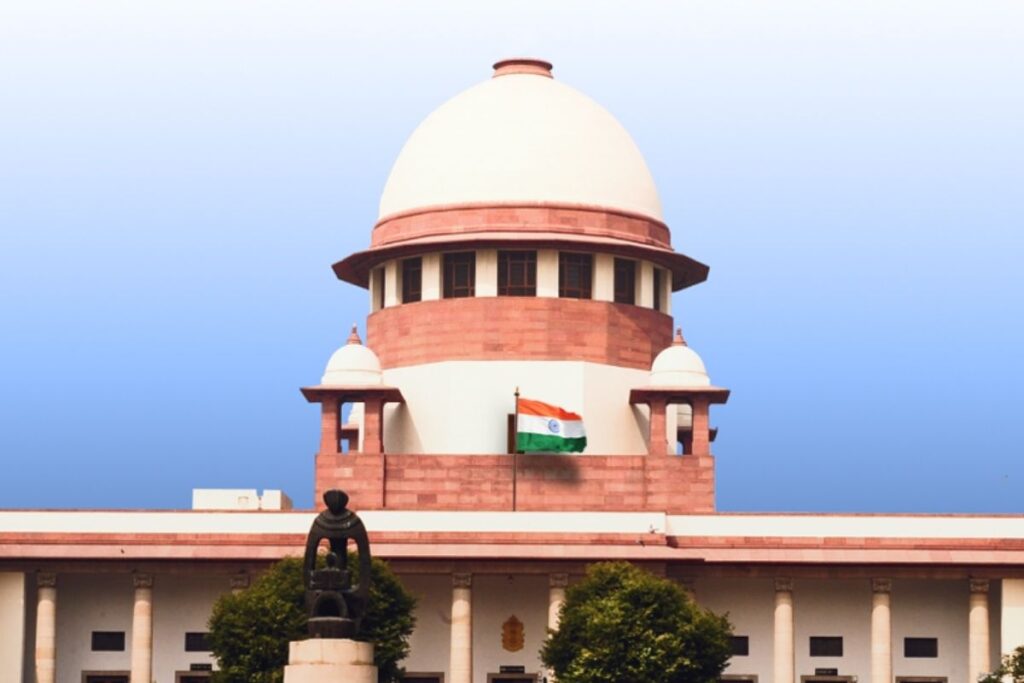
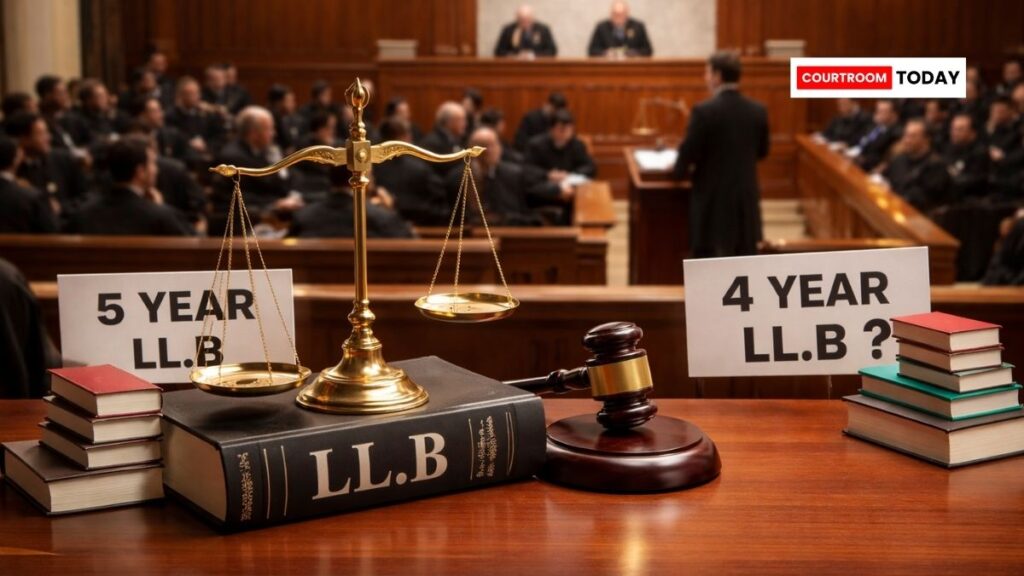
The Supreme Court on Monday declined to intervene in a plea seeking reduction of the five-year integrated LL.B course to four years, stating that the Court cannot impose its own views on matters concerning legal education. The observation came in the case of Ashwini Kumar Upadhyay v. Union of India and Ors., W.P.(C) No. 453/2025.
A Bench comprising Chief Justice of India Surya Kant and Justice Joymalya Bagchi was hearing a public interest litigation filed by advocate Ashwini Kumar Upadhyay. The petition sought directions for the creation of a Legal Education Commission to review the structure, syllabus and duration of law courses in India.
During the hearing, the petitioner argued that most professional courses in the country, such as Chartered Accountancy and engineering programmes, are structured for four years. According to him, the five-year integrated law course discourages talented students from choosing the legal profession.
He submitted that the current duration of the course creates unnecessary barriers and affects the attractiveness of legal education. The petitioner also requested the Court to direct the formation of a commission consisting of eminent jurists, legal scholars, and education experts to examine reforms in legal education.
Responding to the submissions, the Chief Justice noted that questions relating to legal education involve several stakeholders and cannot be decided solely through judicial intervention. The Court emphasised that policymaking in education requires broader consultation.
“But the judiciary is only one stakeholder. We cannot thrust our views. Academicians, jurists, the Bar, social and policy researchers are there. There should be deliberation with them,” the Chief Justice observed during the proceedings.
The Court also referred to the historical development of the integrated law programme in India. The Chief Justice pointed out that the five-year law course was first introduced not by the National Law School of India University, Bengaluru, but by Maharshi Dayanand University in Rohtak in the early 1980s.
When the petitioner argued that many university chancellors were not supportive of the five-year structure, the Bench questioned the need for judicial orders if academic institutions themselves held that view.
“Then why can’t they reduce the term? Why is a court order needed?” the Chief Justice asked during the hearing.
In response, the petitioner submitted that any change in the duration of law courses would require approval from the Bar Council of India, which regulates legal education in the country.
The petition also relied on the National Education Policy, 2020, claiming that the policy encourages four-year undergraduate programmes in professional and academic fields. According to the petitioner, the Bar Council of India has not yet reviewed the syllabus, curriculum, or duration of LL.B and LL.M courses in line with these recommendations.
The plea further contended that the five-year integrated law programme places an excessive financial burden on students from middle and lower-income families. It argued that the extended duration delays the time when students can begin earning and supporting their families.
The Supreme Court ultimately directed that the matter be listed for further consideration in April 2026, leaving the question open for future examination.
Interestingly, this is not the first time the petitioner has raised concerns regarding the duration of legal education. In 2024, a similar plea sought replacement of the five-year integrated course with a three-year programme after Class 12. The Supreme Court had refused to entertain that request, observing that longer legal training helps ensure maturity among future members of the profession.
——————————————–
Have a case update, article, or deal to share? Courtroom Today welcomes contributions from lawyers, law firms, and legal professionals. Write to contact@courtroomtoday.com