
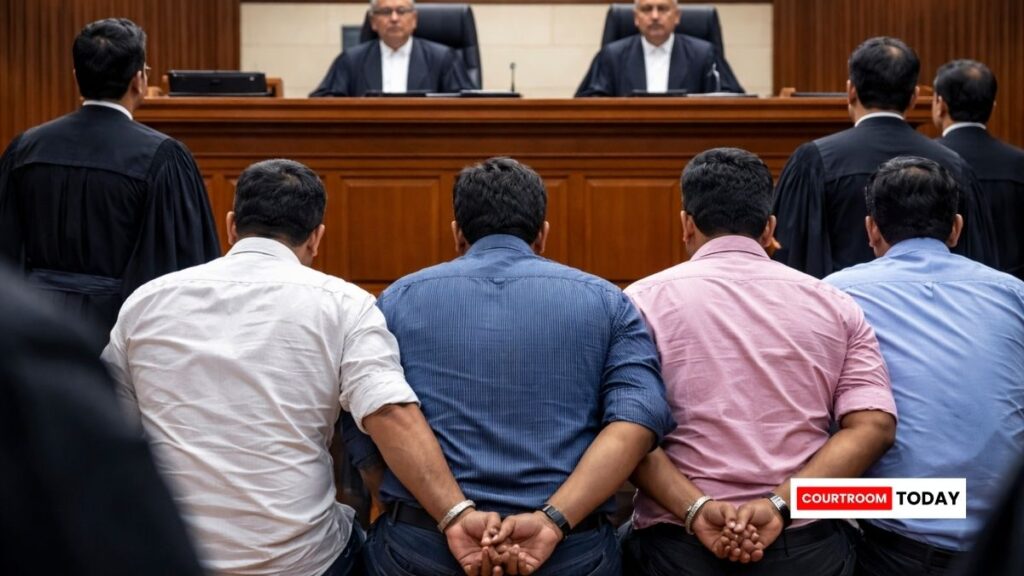
In Rajendra & Ors v. State of Uttarakhand, the Supreme Court has set aside the conviction of four men accused in a 1998 gang rape case, observing that the testimony of the prosecutrix did not inspire sufficient confidence to sustain the conviction.
The decision was delivered by a bench comprising Justices Pankaj Mithal and Prasanna B. Varale. The Court was hearing an appeal against the judgement of the Uttarakhand High Court which had earlier upheld the conviction of the accused for rape and criminal intimidation.
The case dates back to April 7, 1998. According to the prosecution, the complainant alleged that four men intercepted her while she was returning home from a market in Sanjay Colony, Dehradun around 7:30 PM. She claimed that the accused gagged her, covered her eyes with a black handkerchief and forcibly took her to a nearby plot.
The woman further alleged that the accused sexually assaulted her one after another. However, the complaint regarding the alleged incident was filed nearly three months later, on July 31, 1998, before the Senior Superintendent of Police in Dehradun.
In 2000, the trial court convicted all four accused and sentenced them to ten years of rigorous imprisonment along with fines. The Uttarakhand High Court later affirmed the conviction in 2012.
During the pendency of the appeal before the Supreme Court, two of the accused passed away. The remaining accused continued to challenge the findings of the lower courts.
Before the apex court, the defence highlighted several inconsistencies in the prosecution’s case. It argued that the complainant had delayed filing the complaint for nearly three months and had not disclosed the alleged incident to any family member. Instead, she claimed to have narrated the incident to an unidentified woman whose identity she could not recall.
The defence also pointed to contradictions in the statements given by the prosecutrix during different stages of the proceedings. In one version, she stated that the incident took place inside a room, while in another version she claimed it occurred in an open plot.
Further doubts were raised about the absence of independent witnesses. The alleged incident was said to have occurred near a densely populated area, yet no witnesses were produced to support the prosecution’s version.
The Supreme Court also noted that there was prior enmity between the parties due to a dispute over water supply, which the defence argued could have led to false implication.
Examining the evidence on record, the Court found the conduct of the prosecutrix to be inconsistent with what could ordinarily be expected in such circumstances.
“the prosecutrix did not disclose the incident to anybody, neither friends nor family and not even her husband out of shame and ignorance as mentioned in the complaint. This version of the prosecutrix is against a natural conduct of the person. It would have been natural for the prosecutrix to disclose the incident to her family members after some time and not to somebody who is unknown to her and as such it is very difficult to accept the version of the prosecutrix.”, the Court observed.
The bench reiterated the established legal principle that a conviction can be based solely on the testimony of the prosecutrix if it inspires confidence.
“It is the trite in law that the conviction can rest on the solitary version of the prosecutrix, provided it inspires confidence of the Court. In the present case, the version of the prosecutrix utterly fails to inspire confidence of this Court.”, the Court said.
The Court also relied on the precedent in Vijayan v. State of Kerala (2008) 14 SCC 763, where the delay in lodging the FIR and lack of corroborative evidence led to the acquittal of the accused.
After examining the entire record, the Supreme Court concluded that there was no medical evidence or other corroborative material establishing the guilt of the accused beyond reasonable doubt.
Accordingly, the Court allowed the appeal and set aside the judgement of the Uttarakhand High Court, acquitting the appellants of all charges.
——————————————–
Have a case update, article, or deal to share? Courtroom Today welcomes contributions from lawyers, law firms, and legal professionals. Write to contact@courtroomtoday.com