
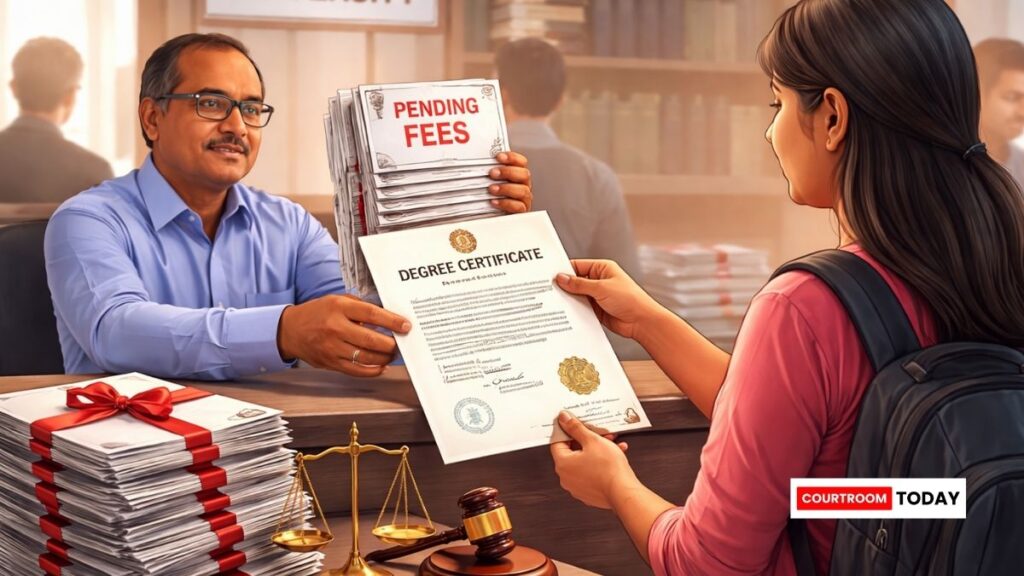
The Telangana High Court in Bhashapaka Pragna Vardhini v. State of Telangana & Ors. held that educational institutions cannot retain a student’s original academic certificates merely because tuition fees remain unpaid. The Court emphasised that such certificates belong to the student and cannot be used as leverage for fee recovery.
Justice Surepalli Nanda, presiding over the case, clarified that institutions have no legal lien over students’ original documents. The Court observed that withholding such certificates violates a student’s right to pursue higher education and employment opportunities.
“The respondent no. 4 [university] cannot withhold the petitioner’s original educational certificates (documents including the Marks Sheet and Degree Certificate) under any pretext. There is no lien on the certificate of the students since the certificate of the student is his/her property. This Court opines that the right of students to obtain their Certificates from one institution to join another institution cannot be denied by the concerned authorities merely because the tuition fee is due and if any amount is due from the petitioner towards such fees, the proper course available to the respondents is to initiate appropriate proceedings for recovery before the competent Court and coercive tactics cannot be adopted by the respondents to make the petitioner pay the tuition fee.”
The Court accordingly directed the university to immediately return all original certificates to the petitioner.
The petitioner, Bhashapaka Pragna Vardhini, completed her B.Tech in Computer Science and Engineering from Mahindra University in 2024. During the convocation ceremony held in August 2024, she was issued only a provisional certificate while her original marks sheet and degree certificate were withheld due to alleged pending fee dues.
She informed the Court that she belonged to a Scheduled Caste community and faced serious financial hardship, which prevented immediate payment of the disputed dues. According to her, the university’s action severely affected her chances of pursuing higher education and employment opportunities.
Before approaching the High Court, the petitioner had filed a complaint before the Telangana State Human Rights Commission. The Commission recommended that the university release the certificates and other documents such as the Transfer Certificate, Study Certificate, and Conduct Certificate within three days.
However, the university challenged the Commission’s recommendation before the High Court and obtained a stay order, resulting in continued retention of the certificates. This prompted the petitioner to file a writ petition seeking a mandamus declaring the university’s action illegal and unconstitutional.
The High Court examined guidelines issued by the Telangana Council of Higher Education as well as regulations framed by the University Grants Commission (UGC). A communication issued by the Council in August 2024 specifically instructed universities not to retain original certificates due to pending fee reimbursement issues.
The Court also referred to the UGC (Grievance Redressal of Students) Regulations, 2018 and earlier guidelines issued in 2007. These regulations clearly prohibit educational institutions from keeping original certificates submitted by students during admission.
In its analysis, the Court observed that multiple judicial precedents have already held that institutions cannot use student documents as a method to enforce financial claims. Such practices were found to be inconsistent with the UGC guidelines and the legal rights of students.
While acknowledging that institutions may have legitimate claims for unpaid fees, the Court clarified that recovery must be pursued through lawful legal proceedings. Retaining academic certificates, the Court said, is an impermissible form of coercion.
Reinforcing the importance of academic documents for students’ future prospects, the Court concluded that educational institutions must not obstruct a student’s progress by withholding essential certificates.
——————————————–
Have a case update, article, or deal to share? Courtroom Today welcomes contributions from lawyers, law firms, and legal professionals. Write to contact@courtroomtoday.com