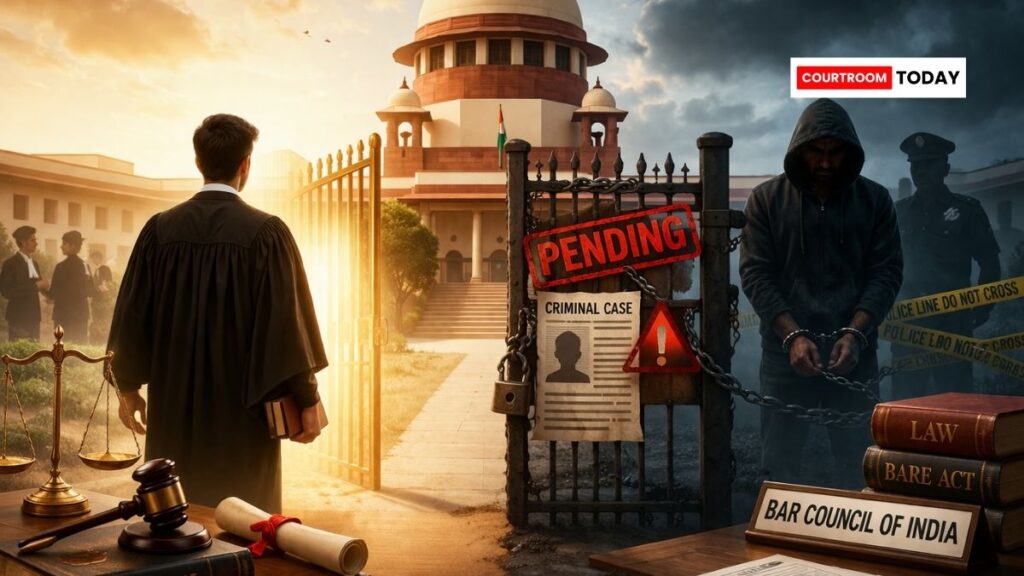
In K R Sudersan Versus The Chairman Bar Council of India and Anr., the Supreme Court examined whether a law graduate can be denied enrolment only because a criminal case is pending against him. The matter has raised larger questions about entry into the legal profession and the limits of regulatory power.
A Bench of Justices Vikram Nath and Sandeep Mehta issued notice on a plea challenging the 2017 Madras High Court ruling that backed a direction to State Bar Councils not to enrol law graduates facing pending criminal cases, except in limited categories.
During the hearing, the Bar Council of India defended the High Court’s view and argued that stricter screening had become necessary. Its counsel told the Court, “All criminals started coming into this profession my lords”, while supporting the continuation of the restriction.
The Bench was not fully convinced by that line of reasoning. Justice Nath immediately asked, “And what happens if after coming into the profession, they become criminals? What do you do against them? Tell us first, what action have you taken against those who become criminals after joining the profession?”
Justice Mehta also questioned the legal basis of the restriction. He asked, “Where is the prohibition in the Advocates Act? Is there any prohibition?” The Court’s remarks indicated concern over whether such a disqualification can continue without express support in statutory law.
The challenge came from a chartered accountant who later studied law with the intention of practising and gaining deeper knowledge of financial laws. He joined law college in the 2019-20 academic year and later applied for enrolment with the Bar Council of Tamil Nadu and Puducherry.
In the enrolment form, he disclosed that a criminal case was pending against him and also submitted the chargesheet as required. His application was rejected because of the existing High Court directions. The case against him relates to offences under Section 120B read with Section 420 of the IPC.
The petitioner argued that he was never a party before the High Court when the earlier directions were issued, yet his right to practise a profession of his choice has been affected by them. He also stressed that he has not been convicted in the pending case.
His plea further says that what was treated by the High Court as a temporary arrangement has effectively continued for nearly a decade. The Supreme Court has now tagged the matter with a pending case, signalling that the broader issue may soon receive closer judicial examination.
——————————————–
Have a case update, article, or deal to share? Courtroom Today welcomes contributions from lawyers, law firms, and legal professionals. Write to contact@courtroomtoday.com