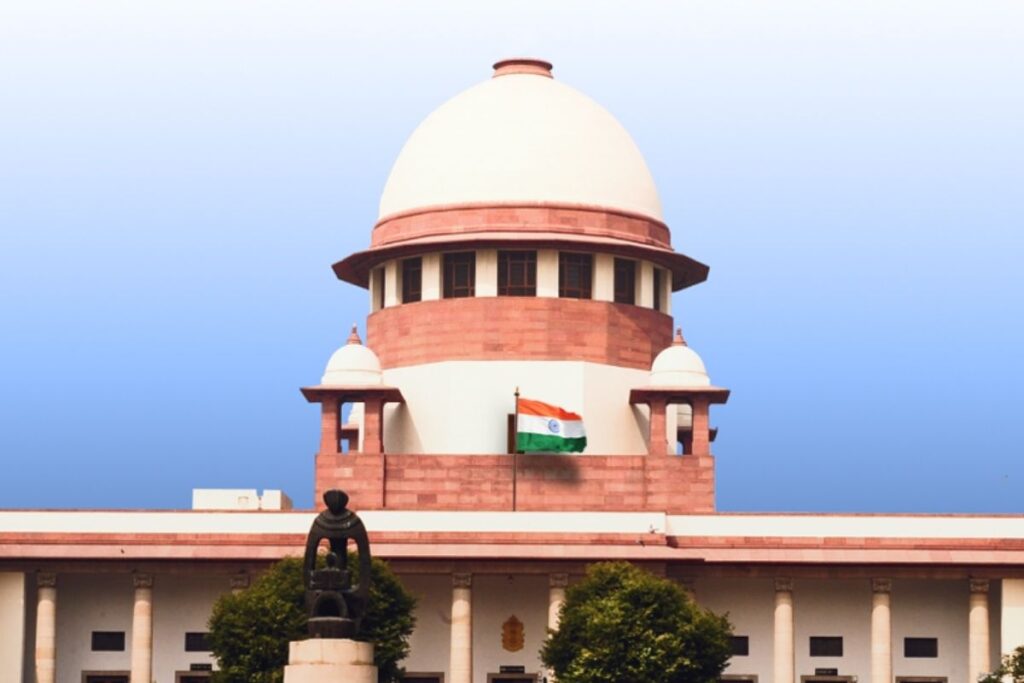

The Supreme Court, in Mohamemd Sayeed Noori v Union of India | WP(c) 341/2026, has refused to entertain a challenge against the Ministry of Home Affairs circular concerning the singing of ‘Vande Mataram’, stating that the plea was premature and based on uncertain concerns.
The petition questioned a circular issued on January 28, which provided guidelines for singing all stanzas of the national song at official functions and in educational institutions. The petitioner argued that the advisory could indirectly pressure individuals to participate, leading to social discrimination against those who choose not to sing.
A bench led by Chief Justice of India Surya Kant, along with Justice Joymalya Bagchi and Justice Vipul Pancholi, observed that the circular is only advisory in nature. The Court highlighted that there is no legal compulsion or penalty attached to the non-compliance of the circular.
At the outset, the Court clarified that the use of the word “may” in the circular clearly indicates that singing ‘Vande Mataram’ is not mandatory. It emphasised that no adverse consequences or sanctions have been prescribed for those who do not follow the advisory.
Senior Advocate Sanjay Hegde, appearing for the petitioner, argued that even without a formal penalty, social pressure could force individuals to comply. He submitted that those who refuse might be “singled out and discriminated against” and could face indirect coercion in the name of patriotism.
Responding to these concerns, the Court noted that such fears were speculative and lacked a clear basis. Justice Bagchi remarked that the petition was founded on “vague apprehensions of discrimination” and did not demonstrate any actual harm arising from the circular.
The Chief Justice further stated that if any real instance of discrimination or enforcement arises in the future, the petitioner would be free to approach the Court again. Until then, there was no ground to interfere with the advisory.
During the hearing, the Solicitor General also raised the question of whether citizens even need to be advised to respect the national song. In response, the petitioner reiterated that “Patriotism cannot be compelled” and stressed the importance of protecting individual conscience under the Constitution.
The Court, however, remained firm that the advisory does not impose any obligation. It also rejected the argument that the circular could diminish the importance of the National Anthem, observing that the protocol merely provides guidance and does not override existing legal provisions.
Ultimately, the Supreme Court dismissed the petition, holding that there was no enforceable requirement in the circular and that the concerns raised were premature.
——————————————–
Have a case update, article, or deal to share? Courtroom Today welcomes contributions from lawyers, law firms, and legal professionals. Write to contact@courtroomtoday.com