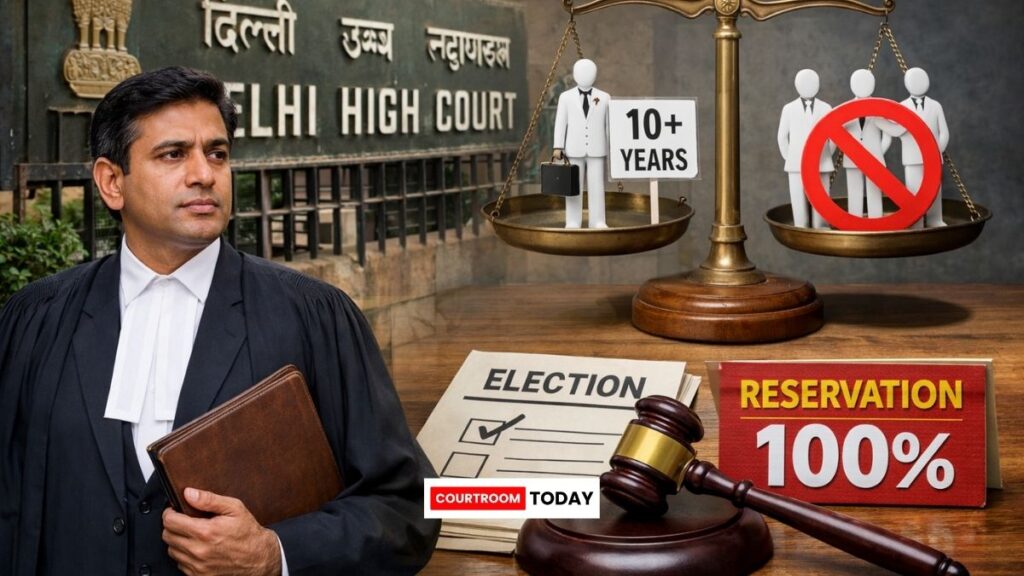
The Delhi High Court, in Ramesh Chandra Singh v Bar Council of Delhi, has refused to allow reservation of six seats in the Bar Council of Delhi (BCD) for junior lawyers with less than ten years of practice. The Court held that such a demand would violate the legal framework governing reservations.
The case arose from an appeal filed by Advocate Ramesh Chandra Singh, who had enrolled in 2022 and contested the BCD elections held in February 2026. He argued that six unreserved seats should be earmarked for lawyers with under ten years of experience.
The Division Bench of Chief Justice Devendra Kumar Upadhyaya and Justice Tushar Rao Gedela examined the existing reservation structure. Out of 23 total seats in the BCD, 12 are reserved for advocates with more than ten years of practice.
Additionally, five seats are reserved for women advocates, in line with the Supreme Court’s direction in Yogamaya MG v Union of India & Ors. This already accounts for a significant portion of the total seats in the Council.
The appellant contended that leaving the remaining six seats open discriminated against younger advocates. He argued that this amounted to a violation of the right to equality under Article 14 of the Constitution.
However, the Court did not accept this argument. It observed that extending reservation to these remaining seats would effectively result in 100% reservation across all positions in the Bar Council, which is legally impermissible.
The Bench clearly stated, “a complete reservation for all the posts of BCD is not permissible.” It further clarified that existing reservations cannot be interpreted to automatically create entitlement for other categories.
The Court also noted that the Advocates Act does not provide any basis for such a demand. The reservation for experienced advocates is specifically recognised under Section 3(2)(b) of the Act, while reservation for women advocates flows from judicial directions.
In contrast, there is no statutory or constitutional backing for reserving seats for advocates with less than ten years of practice. Therefore, the claim of a “vested right” by junior lawyers was rejected.
The Division Bench upheld the earlier decision of the single judge, reaffirming that absence of reservation for a category does not automatically amount to discrimination.
With this ruling, the Delhi High Court has reinforced that reservation policies must strictly align with statutory provisions and constitutional principles, and cannot be expanded beyond permissible limits.
——————————————–
Have a case update, article, or deal to share? Courtroom Today welcomes contributions from lawyers, law firms, and legal professionals. Write to contact@courtroomtoday.com