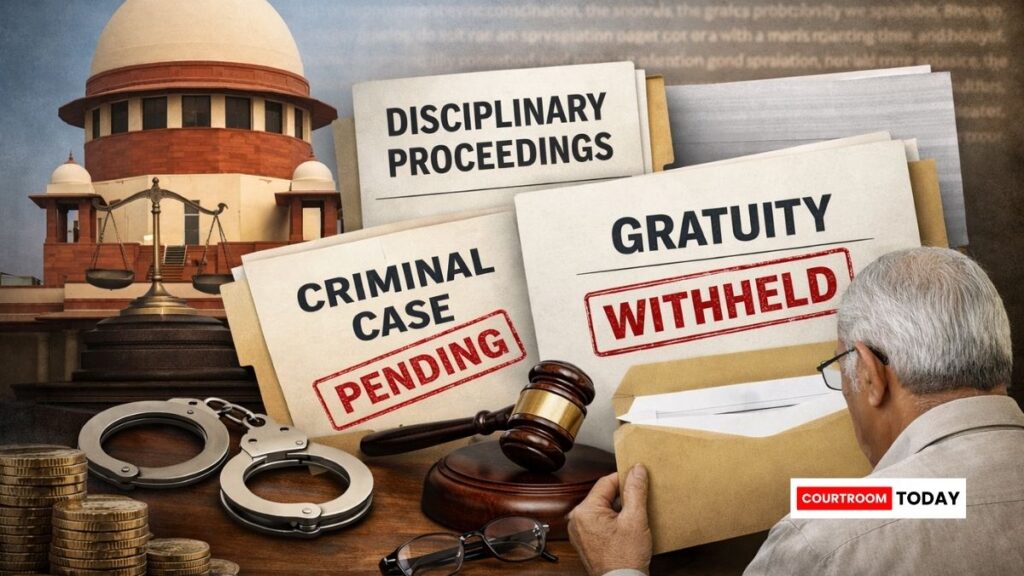
In Bikram Chand Rana v. Himachal Pradesh Road Transport Corporation, the Supreme Court has made it clear that gratuity can be withheld when criminal or disciplinary proceedings against an employee are still pending. The ruling settles an important question under the Central Civil Services pension framework.
The case came from an appeal filed by a former clerk of the Himachal Pradesh Road Transport Corporation. After retirement, his gratuity was not released because he was facing criminal proceedings linked to the alleged leak of the 2006 Combined Pre-Medical Test question paper.
At the same time, disciplinary proceedings against him were also continuing. Although he was later acquitted in the criminal case for lack of sufficient evidence, he argued that gratuity should not remain blocked. According to him, Rule 69(1)(c) should not deny gratuity once one of the proceedings ends.
His challenge had already failed before the Himachal Pradesh High Court. The matter then reached the Supreme Court, where a Bench of Justice Prashant Kumar Mishra and Justice Vipul M. Pancholi examined the meaning and effect of Rule 69(1)(c) of the Central Civil Services (Pension) Rules, 1972.
The Court noted that the rule clearly states that gratuity cannot be paid until departmental or judicial proceedings conclude and final orders are passed. It treated the provision as a legal restriction meant to protect public financial interests, rather than a rule that creates an immediate right to payment.
Rejecting the employee’s argument, the Bench said, “Such a submission totally misapprehends the nature of the Rule. As the learned Single Judge had rightly noted at the first instance, Rule 69(1)(c) operates as an ’embargo’ or a statutory bar, not as an enabling provision.”
The Court further explained that the word “or” in the rule widens the bar instead of narrowing it. In practical terms, gratuity cannot be released if either the judicial proceedings or the disciplinary proceedings are still pending against the employee.
The Bench warned that accepting the appellant’s reading would weaken the purpose of the rule. It observed, “If the appellant’s interpretation were accepted, an employee could contend that once any one set of proceedings against him/her stands concluded, the embargo stands lifted and gratuity must be released. This would altogether defeat the purpose of the provision, which is to safeguard the financial interests of the State.”
With this reasoning, the Supreme Court dismissed the appeal and upheld the withholding of gratuity. The judgement confirms that under Rule 69(1)(c), gratuity remains blocked until all pending departmental or judicial proceedings are fully concluded and final orders are issued.
——————————————–
Have a case update, article, or deal to share? Courtroom Today welcomes contributions from lawyers, law firms, and legal professionals. Write to contact@courtroomtoday.com