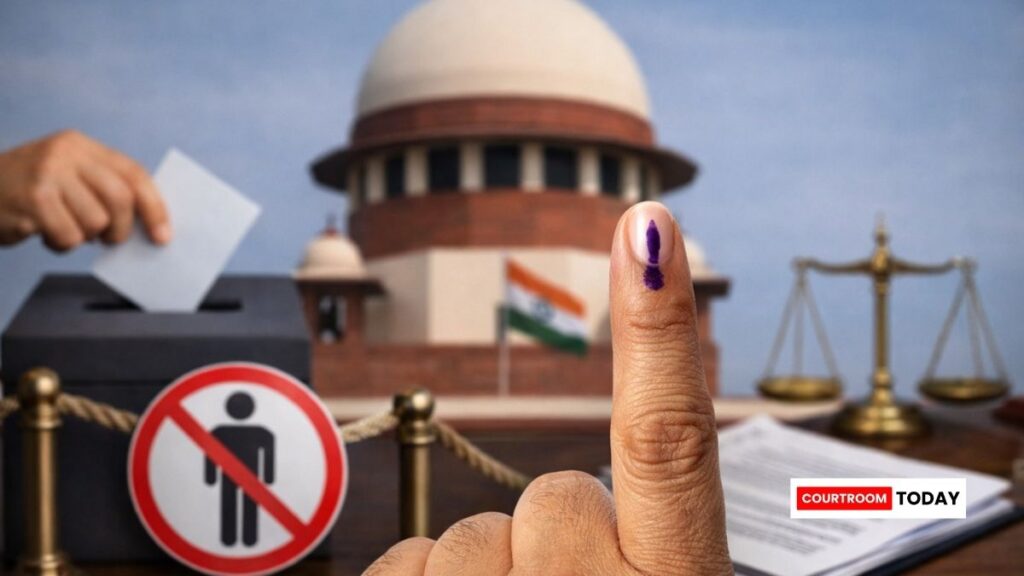
The Supreme Court in Ajay Goel v. Union of India refused to entertain a plea seeking penal action against citizens who do not vote in elections. The Court made it clear that compulsory voting cannot be enforced through judicial directions in a democratic setup.
The matter was heard by a Bench comprising Chief Justice of India Surya Kant, Justice Joymalya Bagchi and Justice Vipul M. Pancholi. The petitioner had sought directions to impose consequences on non-voters, including denial of government benefits.
During the hearing, the Court raised serious concerns about the practicality and constitutional validity of enforcing such a mandate. It noted that India’s diverse socio-economic conditions make compulsory voting difficult to implement in reality.
Highlighting logistical challenges, the Bench observed that even individuals in public offices could face constraints. “If we accept this, then my brother Justice Bagchi has to go to West Bengal and vote though it’s a working day,” said CJI Kant.
The Court also questioned the idea of penalising citizens for not voting. It emphasised that such coercive measures would go against the principles of democracy and individual choice.
“So should we direct their arrest etc? In a country which is governed by rule of law and believes in democracy and we have shown for 75 years how we trust and believe it, so all are expected to go. If they don’t go, they don’t go. So all is needed is awareness. But we cannot compel,” noted CJI Kant.
The Bench further acknowledged that economic realities often influence voter participation. It pointed out that many citizens may skip voting due to livelihood concerns rather than lack of interest.
“If a person who is poor says I will earn my wages how do I vote. What should we say?” the Court remarked, underlining the need to consider ground realities before proposing such measures.
The petitioner’s counsel argued that certain restrictions could act as incentives for voting. Suggestions included barring non-voters from accessing specific government benefits.
However, the Court was not persuaded by this argument. It reiterated that encouraging voter participation must be done through awareness and facilitation, not compulsion.
“App yeh kaam hamare taraf se kar lijiye (you do this for us),” CJI Kant responded, indicating that such policy decisions cannot be enforced by the judiciary.
In its concluding observations, the Court clarified that the question of introducing penalties or disincentives for non-voting falls strictly within the domain of the legislature and the executive.
Accordingly, the plea was disposed of, granting liberty to the petitioner to approach appropriate authorities for consideration of such proposals. The judgement reinforces the principle that democratic participation must remain voluntary and cannot be compelled through punitive measures.
——————————————–
Have a case update, article, or deal to share? Courtroom Today welcomes contributions from lawyers, law firms, and legal professionals. Write to contact@courtroomtoday.com