
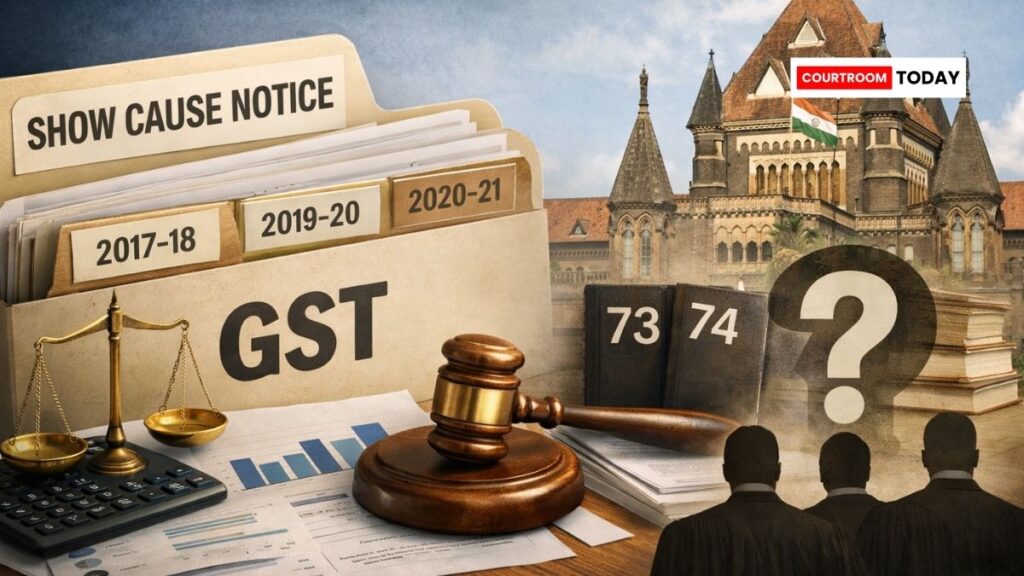
In Rollmet LLP v Union of India & Ors., the Bombay High Court has referred an important GST question to a larger bench, concerning whether a single show cause notice can cover multiple financial years under the CGST Act, 2017.
The Division Bench of Justices GS Kulkarni and Aarti Sathe passed the reference while hearing a batch of petitions filed by Rollmet LLP along with several assessees from sectors including real estate, banking, logistics, manufacturing, and entertainment.
The dispute arose from consolidated show cause notices issued by the GST Department, which clubbed multiple financial years into one proceeding. The petitioners challenged such notices, arguing that the CGST framework operates on a year-wise basis and does not permit such consolidation.
It was contended that Sections 73 and 74 of the CGST Act prescribe clear limitation periods for adjudication. Under Section 73(10), authorities must pass orders within three years in non-fraud cases, while Section 74(10) allows five years in cases involving fraud or suppression.
The petitioners argued that issuing a single notice for multiple years undermines these statutory timelines and violates the structure of the law. According to them, each financial year constitutes a separate assessment unit and must be treated independently for both demand and limitation purposes.
Reliance was placed on earlier rulings, including Milroc Good Earth Developers v Union of India, and decisions of the Nagpur bench in Paras Stone Industries and Rite Water Solutions. These judgments had held that the CGST Act contains no provision allowing the clubbing of different tax periods.
The petitioners also cited similar views expressed by the Madras, Kerala, and Karnataka High Courts, which have emphasised that tax assessments must remain confined to individual financial years, reinforcing the importance of statutory limitation safeguards.
On the other hand, the GST Department relied on contrary decisions from the Delhi High Court in Mathur Polymers and Ambika Traders, as well as the Allahabad High Court ruling in SA Aromatics. These judgments upheld consolidated notices, especially in cases involving fraudulent Input Tax Credit spanning multiple years.
The Court examined Sections 73 and 74 and observed that these provisions form a self-contained code governing demand and recovery under GST. It noted that a plain reading of the law does not expressly prohibit the issuance of a consolidated notice covering multiple periods.
The Bench further remarked that interpreting limitation provisions as a restriction on such consolidation may amount to rewriting the statute. At the same time, it acknowledged the significant divergence in judicial opinions across various High Courts.
Expressing doubt over whether the Milroc ruling correctly reflects the legislative intent, the Court concluded that the issue requires authoritative determination. Accordingly, the matter has been referred to a three-judge bench for final resolution.
——————————————–
Have a case update, article, or deal to share? Courtroom Today welcomes contributions from lawyers, law firms, and legal professionals. Write to contact@courtroomtoday.com