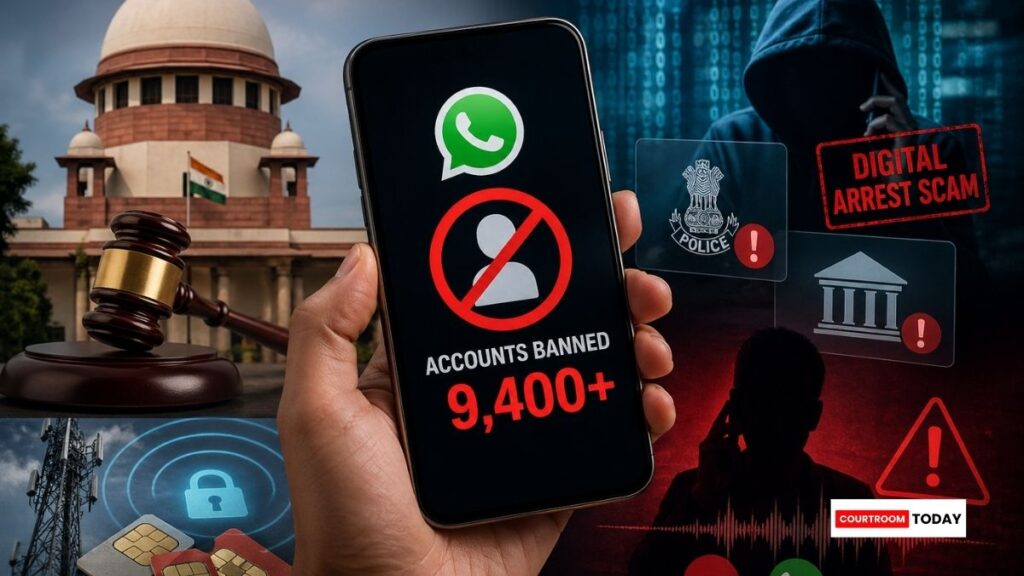
In a significant update before the Supreme Court of India, the Central Government has reported that WhatsApp has banned over 9,400 accounts linked to digital arrest scams since January 2026. The development comes amid growing concerns over online fraud targeting Indian users.
The status report was filed by the Indian Cybercrime Coordination Centre under the Ministry of Home Affairs following earlier directions issued by the Court in February. The bench led by Chief Justice Surya Kant had taken suo motu cognisance of rising cyber frauds, including digital arrest scams.
According to the report, WhatsApp initiated a focused investigation into such scams earlier this year. The exercise involved identifying suspicious patterns, mapping fraudulent networks, and enforcing actions across entire networks. As a result, thousands of accounts allegedly involved in these scams were removed.
To strengthen user protection, WhatsApp is introducing additional safeguards. These include detection systems to identify fake profiles using official logos of police or government authorities. Another proposed feature will warn users when they receive calls from newly created or suspicious accounts, which are often used in such frauds.
The report also highlights broader institutional efforts involving the Reserve Bank of India, Department of Telecommunications, and other stakeholders. Telecom service providers have committed to blocking suspicious SIM cards within two to three hours of identification to prevent misuse in cybercrime activities.
Further, the Central Bureau of Investigation has fixed a threshold of ₹10 crore for taking over digital arrest cases. It has already re-registered multiple cases, including one involving a loss of ₹22.92 crore to a single victim in Delhi.
A key proposal under consideration is the introduction of a Biometric Identity Verification System. This system aims to enable real-time monitoring of SIM card issuance across networks. The Department of Telecommunications has been directed to implement this system by December 2026.
Another important safeguard includes the concept of SIM binding. Under this mechanism, a verified SIM must remain active in the device for apps like WhatsApp to function. Any removal or deactivation of the SIM would automatically disable access, reducing risks of misuse.
Additionally, the RBI has issued a Standard Operating Procedure directing banks to temporarily freeze suspicious transactions. This step is aimed at curbing the use of mule accounts often involved in such fraud schemes.
The Centre has urged the Court to take the report on record and issue further directions to ensure timely implementation of these measures. It has also sought stronger coordination among telecom operators and digital platforms to combat the evolving threat of digital arrest scams.
——————————————–
Have a case update, article, or deal to share? Courtroom Today welcomes contributions from lawyers, law firms, and legal professionals. Write to contact@courtroomtoday.com