In Narayan v. State of Madhya Pradesh, the Supreme Court has clarified an important aspect of bail law under the Bharatiya Nagarik Suraksha Sanhita (BNSS). The Court ruled that conditions under Section 480(3) cannot be applied to offences punishable with imprisonment of up to seven years.
The judgement was delivered by a bench of Justice J.K. Maheshwari and Justice Atul S. Chandurkar while hearing an appeal against cancellation of bail by the Madhya Pradesh High Court.
The case arose from an allegation under the Madhya Pradesh Excise Act, where the accused was found in possession of illicit liquor. The offence carried a maximum punishment of three years and was classified as non-bailable. Despite this, the High Court granted bail but imposed conditions under Section 480(3) BNSS.
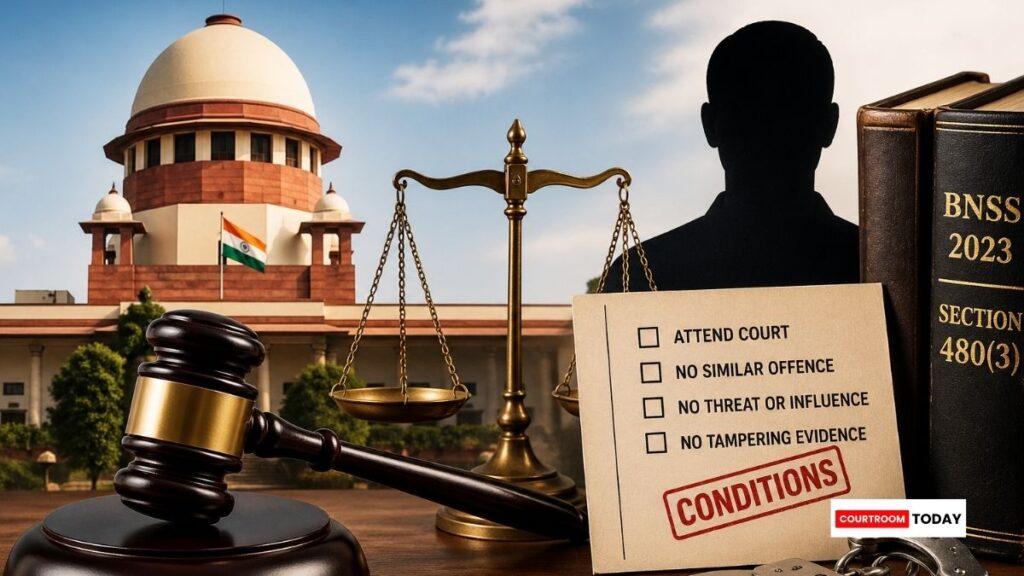
To understand the issue, it is important to note what Section 480(3) provides. This provision allows courts to impose strict conditions when granting bail in serious offences. These include ensuring the accused attends court proceedings, does not commit similar offences, and does not influence witnesses or tamper with evidence.
However, these conditions are not meant for all non-bailable offences. Their application depends on the severity of the offence, particularly the length of punishment prescribed.
After being released on bail, the accused was allegedly involved in a similar offence again. Based on this, the State approached the High Court seeking cancellation of bail. The High Court accepted the argument, stating that the accused had violated the bail conditions and showed a tendency to commit the offence.
The accused then challenged this order before the Supreme Court. It was argued that the High Court made a fundamental error by imposing Section 480(3) conditions in the first place, since the offence was punishable only up to three years.
The Supreme Court agreed with this argument. It clearly stated that Section 480(3) applies only to offences punishable with imprisonment of seven years or more. Since the offence in question did not meet this threshold, the conditions should never have been imposed.
The Court also made an important observation on bail cancellation. It held that if conditions are wrongly imposed, their violation cannot be used as a ground to cancel bail. In this case, the High Court relied entirely on such conditions to cancel bail, which was legally unsustainable.
The Court observed, “since the punishment for subsequent offence is less than five years, the conditions as stipulated in Section 480(3) BNSS are not imposable. Therefore, cancellation of bail on this ground is not justified.”
As a result, the Supreme Court set aside the High Court’s order and restored the bail granted to the accused.
——————————————–
Have a case update, article, or deal to share? Courtroom Today welcomes contributions from lawyers, law firms, and legal professionals. Write to contact@courtroomtoday.com