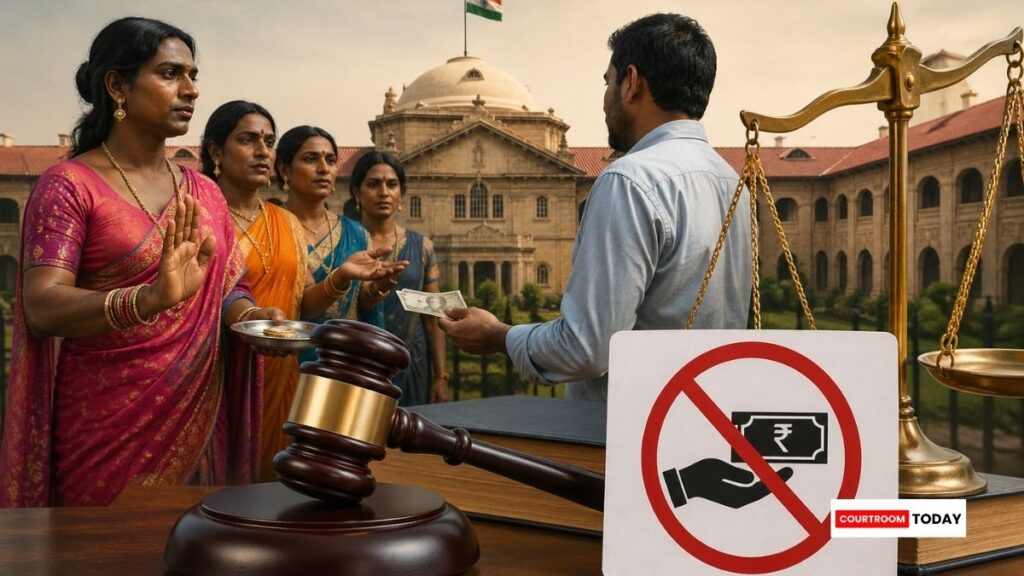
The case of Rekha Devi v State of UP came before the Allahabad High Court, where an important question was raised about whether transgender persons have a legal right to collect “badhai,” a customary gift given during auspicious occasions. The Court clearly ruled that no such legal right exists.
The judgment was delivered on April 15 by a Division Bench of Justice Alok Mathur and Justice Amitabh Kumar Rai. The Court was hearing a petition filed by Rekha Devi, a member of the kinnar community, seeking protection against alleged interference by other kinnars in her claimed territorial area.
The petitioner argued that the practice of collecting badhai had been followed for years and should be recognised as a customary right. She also claimed that disputes over territorial boundaries among members of the community had led to tension and violence, making it necessary for the Court to intervene.
Rejecting these arguments, the Court made it clear that customs alone do not create enforceable legal rights unless recognised by law. It emphasised that collection of money from individuals must have proper legal authority and cannot be justified merely on the basis of long-standing practice.
“There is no legitimate or legal backing permitting any person or individual from collecting / extracting any money, tax, fee or cess from any individual except in accordance with law. Such rights as sought by the petitioner are not recognised by law and accordingly the courts in its power under Article 226 of the Constitution of India cannot legitimise the acts of the petitioner without there being any backing of law,” the Bench said.
The Court further clarified that citizens can only be required to pay money when it is authorised under law. Any form of unauthorised collection would amount to illegal extraction, which cannot be protected or legitimised by judicial orders.
It also expressed concern that recognising such claims could lead to misuse. The Bench warned that allowing such practices might encourage similar activities by other individuals or groups, resulting in widespread extortion.
“In case any indulgence is shown in the respect of the petitioner there may be several other persons / gangs which may be operating and making illegal extraction / extortion from individual and such illegal extraction has never been sanctioned by law in this country and such extraction is an offence under the Bhartiya Nyaya Sanhita,” the Court underscored.
The petitioner had also relied on fundamental rights under Articles 14, 19, and 21 of the Constitution. However, the Court held that these rights cannot be used to justify an activity that has no legal recognition.
The Bench also referred to the Transgender Persons (Protection of Rights) Act, 2019, noting that the law does not provide any protection for such practices. It further mentioned that a new Bill under consideration may change certain aspects of gender determination, but does not address the issue raised in the case.
Accordingly, the Court dismissed the petition and refused to grant any relief.
——————————————–
Have a case update, article, or deal to share? Courtroom Today welcomes contributions from lawyers, law firms, and legal professionals. Write to contact@courtroomtoday.com