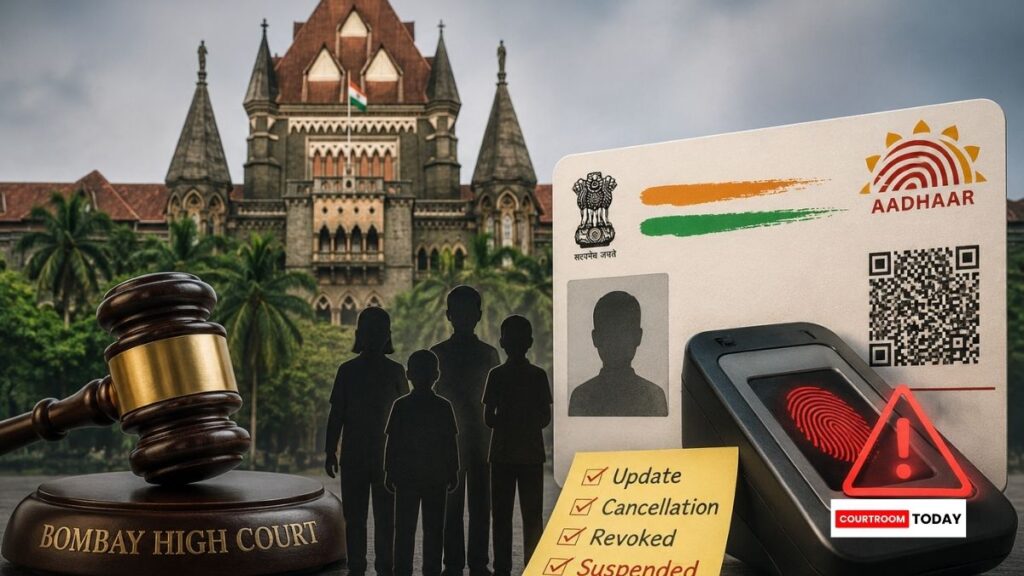
In Rohit Nikalje & Anr v. Regional Officer, UIDAI & Ors, the Bombay High Court has directed the Unique Identification Authority of India (UIDAI) to adopt a more citizen-friendly approach while dealing with Aadhaar-related biometric and technical issues.
A Division Bench of Justices Ravindra V Ghuge and Hiten S Venegavkar observed that genuine citizens should not suffer because of technological irregularities in the Aadhaar system. The Court stressed that people cannot be left without remedies merely because biometric mismatches or database anomalies occur.
The bench also expressed concern over the growing number of cases where citizens are being forced to approach constitutional courts due to Aadhaar-related technical problems. According to the Court, many residents are made to visit multiple offices repeatedly without receiving proper guidance or a clear solution.
The Court said such situations create unnecessary hardship and can deny people access to important services. It added that Aadhaar implementation must remain “citizen-centric, facilitative and constitutionally compliant,” even while maintaining the integrity of the national database.
The matter arose from a petition filed by 19-year-old twin brothers Rohit and Rahul Nikalje. They had received Aadhaar cards in 2012 when they were minors. However, during biometric updates in 2022, they faced contradictory instructions from authorities.
The brothers were initially asked to update their Aadhaar details. Later, they were advised to apply for cancellation. After that, they were informed that the cancellation process had been revoked, and eventually their Aadhaar numbers were shown as suspended.
The confusion reportedly affected their provisional admissions and insurance requirements for sporting activities, including horse riding. The Court noted that if any error existed in the biometrics captured during childhood, the responsibility could not be placed on the twins.
To prevent similar difficulties in future cases, the Court issued several directions to UIDAI. It ordered the authority to provide written guidance explaining remedies available to applicants and to establish facilitation mechanisms at regional offices.
The Court further directed UIDAI to decide such applications within four weeks. If applications are complete and no legal obstacle exists, fresh Aadhaar cards or numbers should be issued promptly.
The twins have now been directed to submit fresh enrolment applications within 15 days, which UIDAI must process according to law within four weeks.
——————————————–
Have a case update, article, or deal to share? Courtroom Today welcomes contributions from lawyers, law firms, and legal professionals. Write to contact@courtroomtoday.com