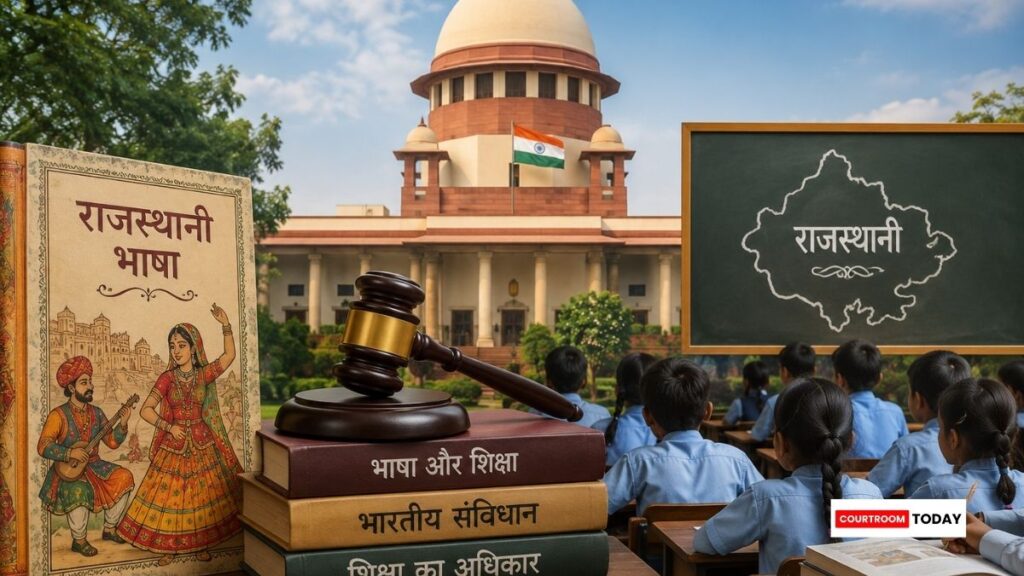
In a significant ruling on mother tongue education, the Supreme Court has directed the Rajasthan government to introduce Rajasthani as a subject in all government and private schools across the State. The judgement was delivered by a Bench of Justices Vikram Nath and Sandeep Mehta.
The Court observed that Rajasthan lacked a proper policy framework for implementing mother tongue-based education despite constitutional and policy support for regional languages. It directed the State to formulate a comprehensive policy in line with the National Education Policy, 2020.
The Bench stated that Rajasthan must take “necessary measures” to recognize and give proper status to the Rajasthani language for educational purposes. The Court further said that the language should progressively be adopted as a medium of instruction, beginning from foundational and preparatory schooling levels.
The Court made it clear that constitutional guarantees relating to education and language rights cannot remain merely theoretical. Stressing the importance of executive action, the Bench remarked, “This Court cannot remain a silent spectator to a stark dilution of rights so clearly recognized in the Constitution, statutes and binding precedents.”
The judges also rejected the State’s stand that only languages included in the Eighth Schedule of the Constitution could be taught in schools as additional languages. The Court termed this approach “pedantic” and pointed out that Rajasthani was already being taught in universities across Rajasthan.
According to the Court, the fact that universities already offer Rajasthani as a subject itself proves that the language has sufficient institutional and academic acceptance. Therefore, the State could not deny similar recognition at the school level.
The judgement directed Rajasthan to take “affirmative and timebound” steps for introducing Rajasthani as a subject in schools in a phased manner. The Court also acknowledged that policy-making generally falls within the executive domain but clarified that constitutional courts cannot ignore executive inaction where constitutional rights are affected.
It further observed that once the Union government itself recognized the importance of education in a language understood by children through legislative measures and policy frameworks, States also become obligated to implement those objectives effectively.
The matter arose from a petition seeking inclusion of Rajasthani as a language for imparting education in schools and for its inclusion in the Rajasthan Eligibility Examination for Teachers syllabus. The Rajasthan High Court had earlier refused relief, holding that the issue involved educational policy matters beyond judicial directions.
The petitioners highlighted that Rajasthani is spoken by nearly 4.36 crore people according to the 2011 Census. Senior Advocate Manish Singhvi appeared for the petitioners. The Supreme Court has now listed the matter for compliance in September.
——————————————–
Have a case update, article, or deal to share? Courtroom Today welcomes contributions from lawyers, law firms, and legal professionals. Write to contact@courtroomtoday.com