
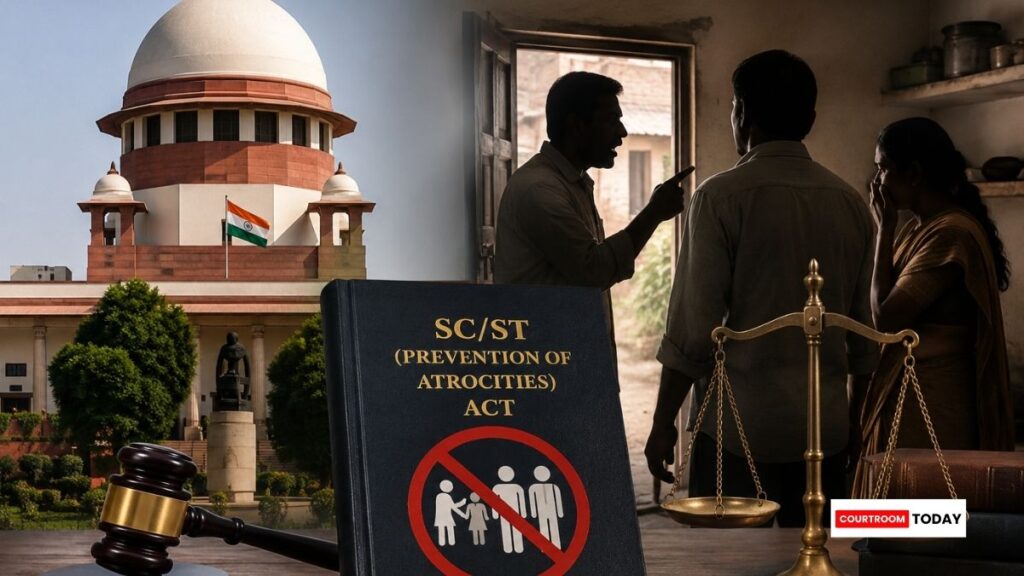
In Gunjan @ Girija Kumari and Others v State (NCT of Delhi) and Another, the Supreme Court has ruled that alleged caste-based abuse inside a private house does not attract offences under the SC/ST (Prevention of Atrocities) Act unless the incident occurred “within public view.” The Court quashed criminal proceedings against the accused after finding that the essential legal requirement under the law was missing.
A Bench of Justice Prashant Kumar Mishra and Justice NV Anjaria observed that for offences under Sections 3(1)(r) and 3(1)(s) of the SC/ST Act to apply, the alleged insult or intimidation must occur at a place visible or accessible to the public. The Court clarified that merely being inside a private location is not enough unless the place is exposed to public gaze.
The Bench stated, “…to make out the offence under Section 3(1)(r) and/or Section 3(1)(s) of the SC/ST Act, the occurrence of the incident and the act and conduct of hurling of caste-based abuses must take place at “a place within public view”.”
The matter arose from an FIR alleging that the accused persons attempted to break the lock of the complainant’s house and used caste-related slurs against him and his wife. The complainant belonged to the Scheduled Caste community. Two accused were his real brothers, while their wives belonged to non-SC/ST communities.
The trial court had framed charges under the SC/ST Act against one accused and criminal intimidation charges under the IPC against all accused persons. The Delhi High Court later declined to interfere with the order framing charges.
Before the Supreme Court, the appellants argued that the FIR itself did not show that the alleged abuses took place in a place “within public view,” which is a mandatory ingredient for invoking the relevant provisions of the SC/ST Act.
Accepting the argument, the Supreme Court carefully examined the allegations in the FIR. The Court noted that the alleged incident occurred inside the complainant’s residential premises and there was nothing to indicate that the place was accessible to the public or visible to outsiders.
The judgment explained that even if an incident occurs at a private place, it can still fall under the Act only if the public has access to witness what happened. However, a residential house, by itself, cannot automatically be treated as a place within public view.
The Court observed, “For an offence to be made out under Sections 3(1)(r) and 3(1)(s) of the SC/ST Act… the requirement that the occurrence has to be “in a place within public view” is not satisfied.”
Based on this reasoning, the Supreme Court allowed the appeal and set aside the proceedings under the SC/ST Act against the appellants.
——————————————–
Have a case update, article, or deal to share? Courtroom Today welcomes contributions from lawyers, law firms, and legal professionals. Write to contact@courtroomtoday.com