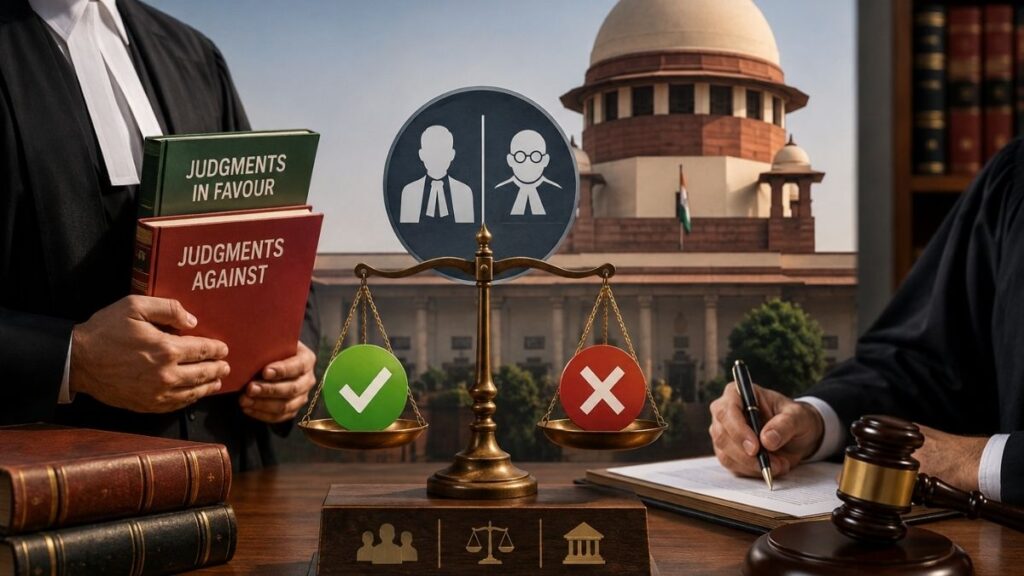
In New India Assurance Company v Dolly Satish Gandhi and another, the Supreme Court has said that lawyers must place before the court not only judgments supporting their case but also those that may go against them. The Court stressed that both advocates and judges share responsibility for maintaining consistency in the justice delivery system.
A Bench of Justice Sanjay Karol and Justice Vipul M. Pancholi made the observation while deciding whether Mediclaim reimbursements can be deducted from compensation granted under the Motor Vehicles Act. The Court ultimately ruled that such reimbursements cannot be deducted from compensation awarded to accident victims.
The Bench expressed concern over conflicting rulings delivered by different High Courts, and sometimes even different Benches of the same High Court, on identical legal questions. According to the Court, such inconsistencies create uncertainty in law and make litigation more complicated for litigants and courts alike.
The Court observed that unresolved contradictions in judicial decisions lead to confusion and weaken consistency in the legal system. It noted that lawyers have a professional duty towards the court in addition to their obligation to secure relief for their clients.
“It is this duty towards the Court which requires them to bring to the Court’s notice judgments both that aid their case and also those that do not,” the Bench stated.
The Supreme Court explained that a lawyer’s understanding of law and facts allows them to distinguish adverse precedents while still effectively arguing their client’s case. It added that this duty has become even more important because courts across the country deliver a large number of judgments every day.
Referring to the modern judicial system as “polyvocal,” the Court said judges hearing matters may not always be aware of the latest decisions delivered by different courts. Therefore, advocates must assist the court by disclosing all relevant judgments to ensure uniformity and consistency.
At the same time, the Court clarified that the responsibility cannot be placed entirely on lawyers. It stated that courts themselves have an independent duty to apply the correct law, maintain consistency with precedents, and avoid delivering per incuriam decisions.
“The Court itself has an independent tri-fold duty, to apply correct law even if the counsel does not cite the same, ensure consistency with precedent, and avoid per incuriam decisions,” the Bench observed.
The judgment also acknowledged the practical difficulties faced by judges, noting that courts often hear nearly a hundred matters in a day while simultaneously dictating orders and writing judgments across different areas of law.
Even then, the Court emphasised that both the Bar and the Bench are integral parts of the justice delivery system and must act with a sense of service to reduce uncertainty in law and help minimise pendency in courts.
——————————————–
Have a case update, article, or deal to share? Courtroom Today welcomes contributions from lawyers, law firms, and legal professionals. Write to contact@courtroomtoday.com