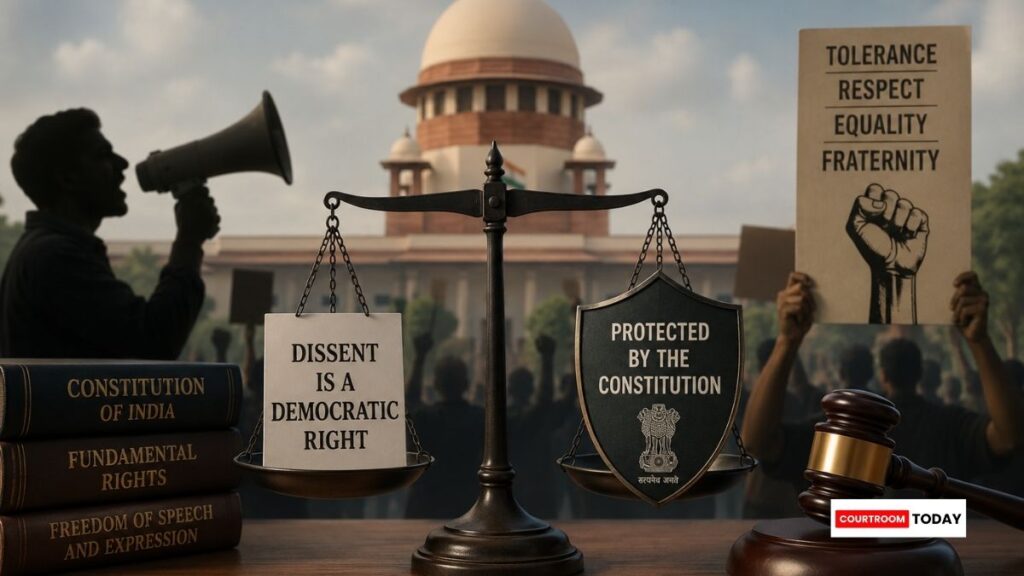
In a significant constitutional message, Justice Ujjal Bhuyan stressed that the right to dissent must be safeguarded against coercive actions by both State and non-State actors, particularly fanatical and intolerant groups. He warned that intolerance weakens democratic values and prevents the growth of an inclusive society.
Speaking at the valedictory ceremony of the Smt. Nirmala Devi Bam International Moot Court Competition organised by the Indore Institute of Law, Justice Bhuyan said the Constitution protects liberty of thought, expression, belief, faith and worship. According to him, tolerance and respect for differing opinions form the foundation of India’s constitutional structure.
Referring to his concurring opinion in Atul Mishra v. Union of India, Justice Bhuyan explained that fraternity under the Constitution promotes collective brotherhood, dignity and equality among citizens. He observed that dissent and tolerance are inseparable from constitutional democracy.
He said, “Disagreements with the beliefs and ideology of others are no reason for their suppression because tolerance recognises that there can be more than one view.” He further remarked that intolerance grows from a rigid belief in the superiority of one’s own ideology over others.
Justice Bhuyan added, “When intolerance reigns, reason takes a back seat. An intolerant society can never be a progressive, inclusive society.” He emphasised that dissent should never be penalised and individuals expressing contrary opinions must be protected.
The judge also recalled Dr. B. R. Ambedkar’s warning that liberty without fraternity could lead to the dominance of a few over the many. According to him, fraternity ensures that multiple ideologies and beliefs can peacefully coexist within society.
Discussing the role of free speech, Justice Bhuyan referred to movements led by Martin Luther King Jr. and other struggles for equality and dignity. He said freedom of expression has historically empowered marginalised communities to participate in democratic and constitutional discourse.
He further stated that constitutional values such as justice, equality and liberty must ultimately be judged from the perspective of those who remain unheard and marginalised, not merely from the experiences of the privileged sections of society.
Justice Bhuyan concluded by observing that constitutionalism must be understood from the viewpoint of “constitutional losers, not winners,” adding that human rights become meaningful only when society takes human suffering seriously.
——————————————–
Have a case update, article, or deal to share? Courtroom Today welcomes contributions from lawyers, law firms, and legal professionals. Write to contact@courtroomtoday.com