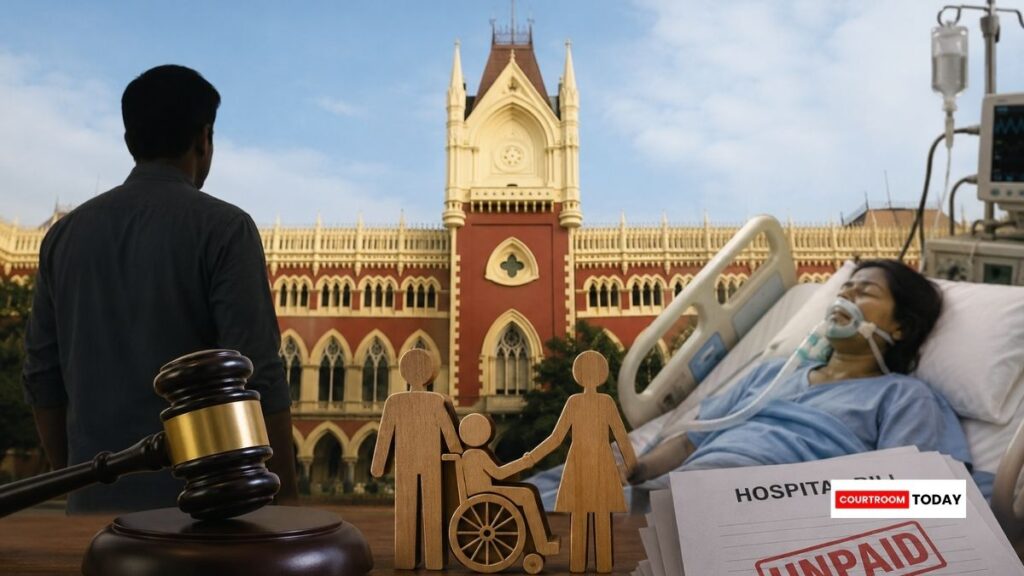
In Apollo Multispecialty Hospitals Limited & Anr. v. State of West Bengal & Ors., the Calcutta High Court directed a man to take his wife home after she remained admitted in a private hospital for nearly four years following a road accident. The Court observed that a hospital cannot function as a shelter home for abandoned patients.
Justice Krishna Rao passed the order after considering the medical condition of the patient, Poonam Gupta, who had been admitted to Apollo Multispecialty Hospitals in September 2021 with severe head injuries suffered in a road accident. She had undergone emergency craniotomy and remained under treatment since then.
The hospital approached the High Court seeking directions against the State authorities for framing guidelines to deal with cases where patients continue to stay in hospitals despite being medically fit for discharge. The hospital also requested that the patient be shifted to a government-run facility.
According to the hospital, the patient’s husband initially paid only Rs.15,000 during admission and later refused to either clear the medical dues or take his wife home. The hospital informed the Court that the unpaid bill had crossed Rs.1.09 crore between September 2021 and September 2024. Out of this amount, the insurance company had approved only Rs.5.7 lakh.
The husband argued before the Court that he lacked the financial capacity to bear the treatment expenses or personally care for his wife. He also alleged negligence on the part of the hospital and claimed that her condition had worsened during treatment.
To assess the patient’s present medical condition, the Court directed the Medical Superintendent of Calcutta Medical College and Hospital to form a specialist medical committee. The team included experts from neurology, surgery, medicine, geriatrics and gynecology.
The committee examined the patient and reported that she was conscious, stable and capable of feeding herself. It further stated that she no longer required ICU-level treatment and could remain at home with rehabilitation support.
The medical report noted, “Thus, we had come to the opinion that patient can be discharged for homestay. She needs physical rehabilitation which can be done at home.”
The committee also clarified that tracheostomy tube care could be handled at home by trained paramedical staff, while replacements could be carried out in hospitals whenever necessary.
The State Government informed the Court that shelters meant for the urban homeless were not equipped to care for long-term recovering patients and no suitable State facility existed for such cases.
Taking note of these findings, the Court directed the husband to take his wife home within one week from discharge and ensure proper care. It further ordered that any future treatment required by the patient should be provided through government hospitals.
The Court also directed State authorities to provide a wheelchair free of cost before discharge. Considering the husband’s financial condition, the Court held that the hospital would not recover dues from either the patient or her husband, though it remained free to pursue insurance claims in accordance with law.
Justice Rao clarified that the order had been passed in “peculiar circumstances” and should not be treated as a precedent.
——————————————–
Have a case update, article, or deal to share? Courtroom Today welcomes contributions from lawyers, law firms, and legal professionals. Write to contact@courtroomtoday.com