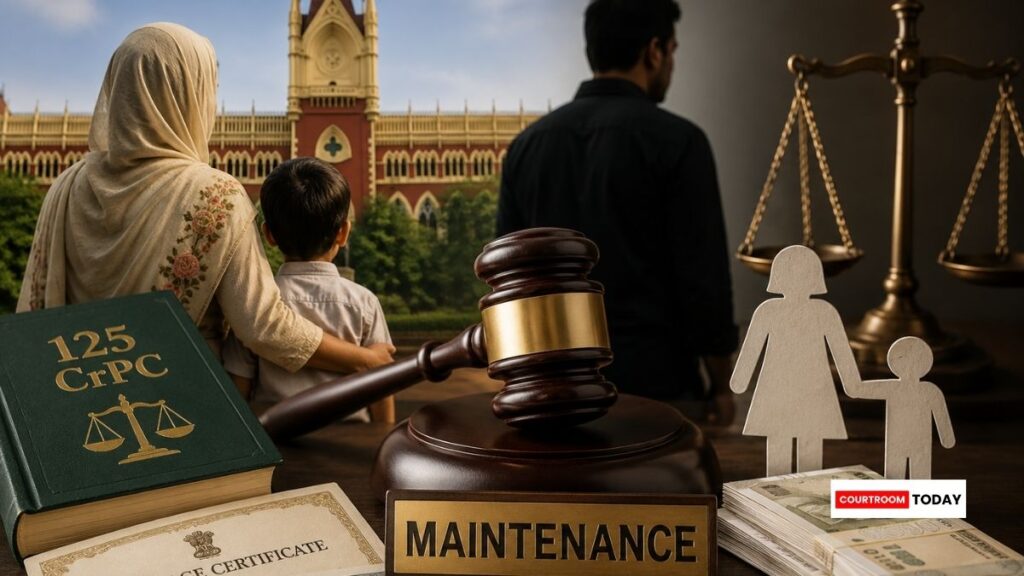
In Bonoshree Hazra @ Mollah v. State of West Bengal & Anr., the Calcutta High Court has held that a Muslim man cannot avoid paying maintenance to a Hindu woman who married him under Muslim rites merely by disputing the validity of the marriage, unless the marriage is first declared void by a competent court.
Justice Chaitali Chatterjee Das restored an interim maintenance order in favour of a woman and her minor son, observing that denying maintenance despite prima facie evidence of marriage and paternity would amount to “gross illegality.”
The case arose from a petition filed by Bonoshree Hazra alias Bonoshree Hazra Mollah, who claimed that she married the respondent, a Sub-Inspector of Police, in August 2016 after converting to Islam. The marriage was allegedly performed according to Muslim customs and registered before a Kazi in Asansol. A son was born to the couple in January 2017.
The petitioner alleged that she faced cruelty and threats before being deserted by her husband in 2018. She later approached the court under Section 125 CrPC seeking maintenance for herself and the child.
In March 2023, the Judicial Magistrate at Asansol granted interim maintenance of ₹5,000 per month to the woman and ₹4,000 to the child. However, the Additional Sessions Judge later set aside the order after the husband disputed both the marriage and the child’s paternity.
The revisional court had also questioned the validity of the alleged conversion because the woman continued using her Hindu name. Challenging this decision, the petitioner approached the High Court.
The High Court observed that the revisional court wrongly treated disputed questions as finally decided at the interim stage. Justice Das noted that the woman had produced a marriage certificate carrying signatures and photographs of both parties, along with the child’s birth certificate naming the respondent as the father.
The Court also took note that proceedings under Section 498A IPC had earlier been initiated against the respondent, where the marriage itself was never disputed.
Relying on the Supreme Court judgments in Chand Patel v. Bismilla Begum and Mohammed Salim v. Shamsudeen, the High Court reiterated that under Hanafi Muslim law, a marriage between a Muslim man and a Hindu woman is considered “irregular” (fasid) and not void (batil).
Justice Das clarified that such a marriage continues to remain valid until declared void by a competent court, and during that period, the wife and children remain entitled to maintenance under Section 125 CrPC.
The Court further observed that proceedings under Section 125 CrPC are summary in nature and strict proof of marriage is not required at the interim stage. Referring to Dwarika Prasad Satpathy v. Bidyut Prava Dixit, the Court stressed that maintenance provisions are intended to secure social justice for women and children.
Allowing the revision petition, the High Court restored the Magistrate’s order granting interim maintenance and directed the respondent to continue making payments while the trial court completes the proceedings expeditiously.
——————————————–
Have a case update, article, or deal to share? Courtroom Today welcomes contributions from lawyers, law firms, and legal professionals. Write to contact@courtroomtoday.com