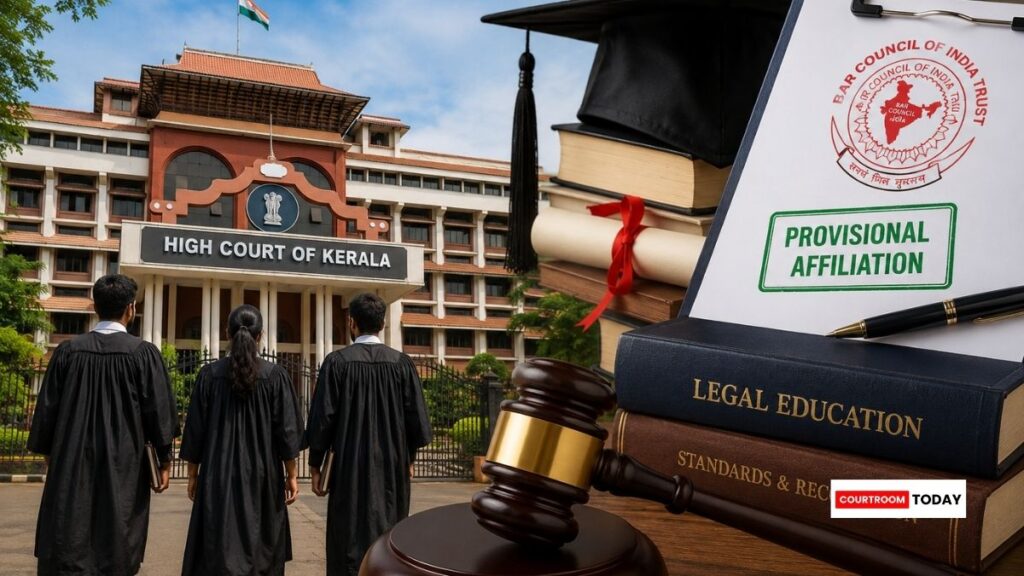
The Kerala High Court has closed the petition in Muhammed Anwar Saidu v Bar Council of India & Ors after Government Law College, Kozhikode received provisional affiliation from the Bar Council of India for six months.
Justice Bechu Kurian Thomas noted that the college had cleared its pending payments and fulfilled the conditions imposed by the BCI. The affiliation would remain effective provided the institution continued to maintain the legally required standards of legal education.
The Court recorded the submission made by the BCI’s standing counsel that provisional recognition had already been issued. Its continuation would depend upon the college complying with the prescribed educational and regulatory standards during the relevant period.
“Since the 3rd respondent (GLC) has already cleared the defaulted amounts and has also complied with all the conditions, provisional affiliation has already been granted. The standing counsel also submitted that the affiliation will continue as long as the college maintains the standards of education required by the provisions of law.”
The Court further observed that the main grievance raised in the petition had been addressed following the grant of provisional affiliation. It therefore found no reason to keep the proceedings pending and formally closed the writ petition.
“Since the provisional affiliation is already issued and the compliance of conditions for continuance of affiliation is a matter that has to be complied with by the 3rd respondent, I am of the view that the grievance in the writ petition stands redressed. Accordingly the writ petition is closed,” the Court added.
However, the High Court directed the principal of Government Law College, Kozhikode to take necessary steps for obtaining regular affiliation from the BCI without unnecessary delay. The direction seeks to prevent any further uncertainty regarding the recognition of the college’s law programmes.
The petition was filed by Muhammed Anwar Saidu, a graduate of the college’s five-year integrated BBA LLB (Hons) programme. He raised concerns after discovering that the institution did not have a valid BCI affiliation for the relevant course.
The affiliation lapse reportedly affected the petitioner when he applied to Canada’s National Committee on Accreditation for further studies and professional opportunities. His law degree was treated as unqualified because the institution lacked valid recognition from the BCI.
During earlier hearings, the High Court had expressed concern about the impact of the affiliation problem on existing students and former graduates. It had urged the State government and college authorities to resolve the issue promptly.
The Court had also highlighted that uncertainty over BCI recognition could seriously affect academic progression, enrolment opportunities and the professional future of students. The grant of provisional affiliation provides immediate relief, while regular recognition remains necessary for long-term certainty.
——————————————–
Have a case update, article, or deal to share? Courtroom Today welcomes contributions from lawyers, law firms, and legal professionals. Write to contact@courtroomtoday.com