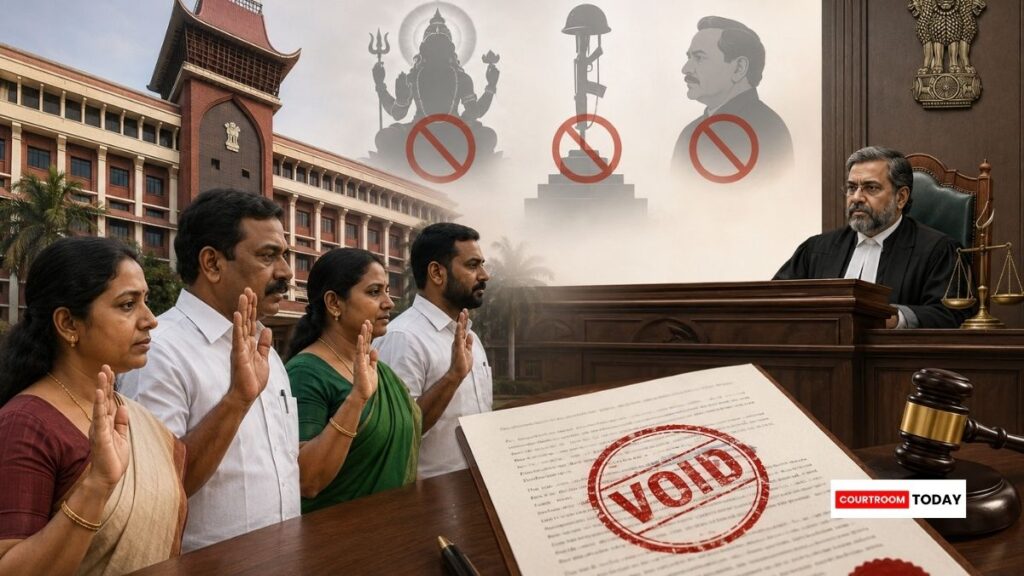
In Adv SP Deepak v The Kerala State Election Commission, the Kerala High Court has invalidated the oaths taken by 20 BJP councillors of the Thiruvananthapuram Municipal Corporation after they invoked deities, political martyrs and movements while assuming office.
Justice PV Kunhikrishnan also invalidated the oath taken by Congress member Sunil Chuvattupadam of the Vadakkencherry Grama Panchayath. Chuvattupadam had referred to former Kerala Chief Minister Oommen Chandy while taking his oath.
Chuvattupadam had stated, “By God’s blessing in the name of Oommen Chandy.” The Court found that this wording did not comply with the legally prescribed form applicable to elected representatives of local bodies.
The High Court explained that the Kerala Municipality Act, 1994 requires elected representatives to take the oath either in the name of God or through a solemn affirmation. The prescribed wording must be followed without introducing additional names, beliefs or expressions.
“Taking an oath by an elected person in a democracy means that the elected person is promising the electorate that he will be honest, he will follow the constitution and the rule of law, and he will serve the people with sincerity. Therefore, when he takes the oath, it should be taken as prescribed by the relevant statute and rules.” the Court said.
The petitions questioned the oath-taking ceremony held on December 21, 2025, following the Thiruvananthapuram Corporation elections. CPI(M) councillor SP Deepak challenged the manner in which the 20 BJP members had taken their oaths.
The councillors had reportedly invoked names such as Gurudeva, Bharathamba, Kaavilamma, Attukal Amma, Sree Padmanabha Swami and Ayyappa. Some councillors also referred to martyrs associated with their political organisation.
A connected petition filed by C Kannan challenged Chuvattupadam’s oath. The Court held that the statutory expression “God” cannot be replaced or expanded by mentioning a particular deity, person, political ideology, organisation, movement or symbolic entity.
Referring to Sree Narayana Guru’s teaching, the Court observed, “I am forced to say why we do not call the almighty of all religions with a common name, God? If that happens, there ends the whole problem.”
It further stated, “We need not expand God by name. Let the almighty bless all! I leave it there. The upshot of the above discussion is that the writ petitions are to be allowed.”
The Court directed the State Election Commission and competent authorities to arrange fresh oath-taking within four weeks. However, it clarified that the councillors would not lose their positions merely because their earlier oaths were defective.
Relying on Section 531 of the Municipality Act, the Court protected the official actions and decisions taken by the councillors until the date of the judgement. They have been permitted to take fresh oaths in the legally prescribed manner.
——————————————–
Have a case update, article, or deal to share? Courtroom Today welcomes contributions from lawyers, law firms, and legal professionals. Write to contact@courtroomtoday.com