
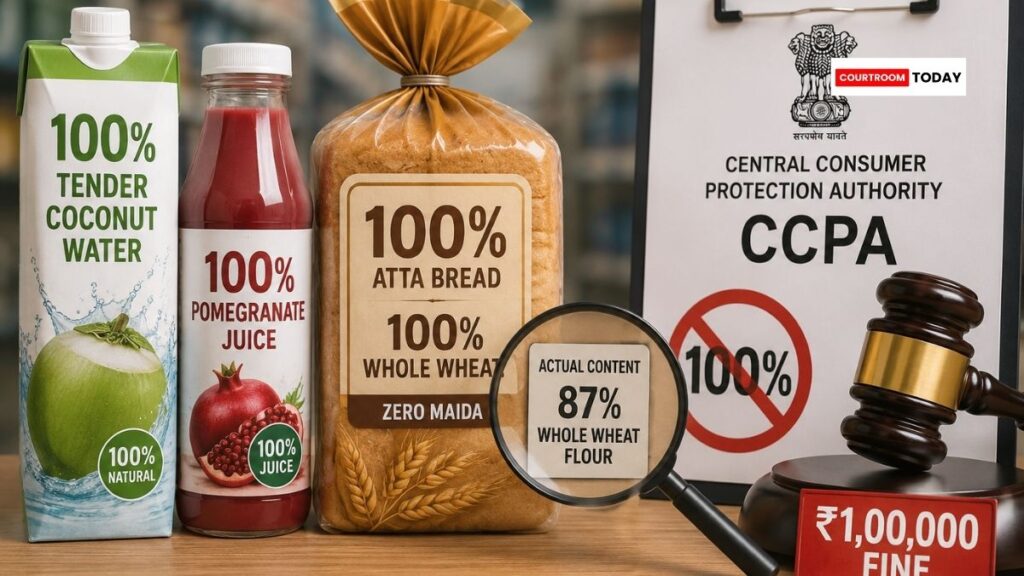
The Central Consumer Protection Authority (CCPA) has imposed penalties of ₹1 lakh each on Storia Foods and Beverages Pvt. Ltd. and Mrs. Bectors Food Specialities Ltd. for using misleading “100%” claims in advertisements for beverages and bread products.
The orders, passed on June 18, 2026, underline that the expression “100%” carries a definite and absolute meaning. According to the Authority, businesses cannot use the term loosely when the actual ingredients or composition do not fully support the representation made to consumers.
In Storia’s case, the CCPA examined claims including “100% Tender Coconut Water” and “100% Juice” for several beverage variants. These descriptions appeared on the company’s website and prominent online marketplaces such as Amazon, Flipkart, BigBasket, Blinkit, JioMart and Zepto.
The Authority found that the coconut water drink contained 9.6% coconut water concentrate that was reconstituted with water. It also noted that the product carried a “100% Natural” claim despite containing the Class II preservative INS 202.
Although the packaging mentioned that the beverage was reconstituted, the disclosure appeared in fine print. The CCPA concluded that such limited disclosure could not correct the stronger overall impression created by the prominent advertising claim.
Storia was held responsible for violating consumers’ right to accurate information, making a misleading representation about product composition and engaging in an unfair trade practice under Sections 2(9), 2(28) and 2(47) of the Consumer Protection Act, 2019.
The proceedings against Mrs. Bectors concerned English Oven bread advertised through phrases such as “100% Atta Bread”, “100% Whole Wheat Bread” and “Taste of 100% Goodness”. The company acknowledged that the product contained 87% whole wheat flour.
The CCPA rejected the argument that “100% Atta” merely identified the source of grain. It held that the combined presentation of “100% Whole Wheat” and “Zero Maida” could lead an ordinary buyer to believe that the bread was entirely made from whole wheat flour.
The Authority stressed that consumer perception, rather than the advertiser’s claimed intention, is central while deciding whether an advertisement is misleading. Good faith cannot excuse a representation that is likely to create a false understanding about a product.
Both companies were found liable for misleading advertisements and unfair trade practices. They were directed to withdraw the disputed claims immediately from packaging, websites and digital platforms, in addition to paying the penalties imposed.
The orders rely on the Consumer Protection Act, 2019 and the 2022 guidelines governing misleading advertisements and endorsements. The CCPA clarified that “100%” must reflect complete factual accuracy and cannot be treated as approximation, promotional exaggeration or an expression open to qualification.
——————————————–
Have a case update, article, or deal to share? Courtroom Today welcomes contributions from lawyers, law firms, and legal professionals. Write to contact@courtroomtoday.com