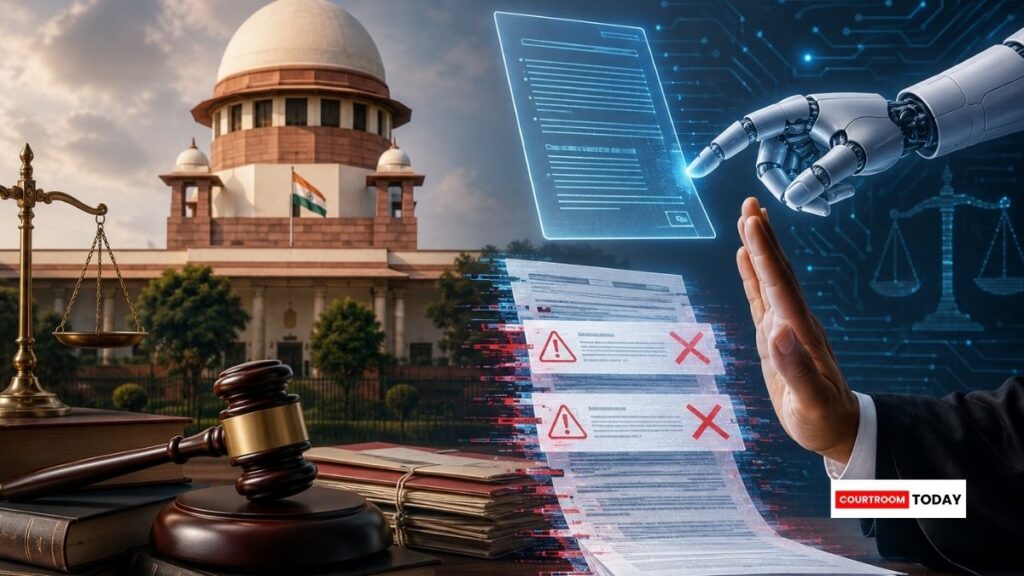
In Pooja Ramesh Singh v. Jammu and Kashmir Bank Ltd. & Anr., the Supreme Court has ruled that advocates commit professional misconduct when they cite AI-generated fake precedents without verification. It also held that judicial decisions relying on fabricated authorities are void in law.
A Bench of Justice P.S. Narasimha and Justice Alok Aradhe adopted a “zero-tolerance” approach towards fake or hallucinated judgments. The Court said the integrity of judicial decision-making is compromised whenever non-existent legal material enters the adjudication process.
The Supreme Court set aside orders passed by the National Company Law Tribunal and the National Company Law Appellate Tribunal. Both tribunals had relied on purported judicial precedents that could not be traced in recognised legal databases.
The Court observed, “It is a misconduct on the part of an advocate to cite such judgments without verification. Equally, it is a serious lapse if a judge relies on such a fake or hallucinated AI-generated material as precedents in support of the determination.”
It further declared that a ruling affected by fabricated material is “no decision in the eyes of the law.” The Court clarified that such an order must be set aside even when the fake precedent had only an indirect role in the final determination.
The matter arose from insolvency proceedings initiated by Jammu and Kashmir Bank Ltd. against Essel Infraprojects Ltd. under Section 7 of the Insolvency and Bankruptcy Code. The proceedings concerned a corporate guarantee given for credit facilities extended to Pan India Utilities Distribution Company Ltd.
The NCLT, Mumbai admitted the insolvency application on August 28, 2024, after recording a default of ₹87.43 crore. The NCLAT upheld that order on September 11, 2025.
Before the Supreme Court, Senior Advocate Madhavi Divan, representing suspended director Pooja Ramesh Singh, argued that six decisions cited in the tribunal orders either did not exist or did not support the propositions attributed to them.
An affidavit submitted before the Court confirmed that several cited authorities were unavailable in recognised legal databases. The respondent’s counsel maintained that these decisions had not been cited during arguments and had apparently been relied upon independently by the NCLT.
The Supreme Court also questioned how the NCLAT, as the statutory appellate tribunal, failed to detect the non-existent judgments. It warned that relying on fabricated precedents amounts to subversion of the rule of law.
The Bench directed the Bar Council of India to examine the issue seriously and frame guiding principles for preventing similar incidents. It also asked the regulatory body to consider appropriate disciplinary consequences for violations.
The Court clarified that its judgement does not restrict the legitimate use of artificial intelligence. Its concern is limited to presenting or relying upon fake AI-generated material as though it were an authentic judicial precedent.
——————————————–
Have a case update, article, or deal to share? Courtroom Today welcomes contributions from lawyers, law firms, and legal professionals. Write to contact@courtroomtoday.com