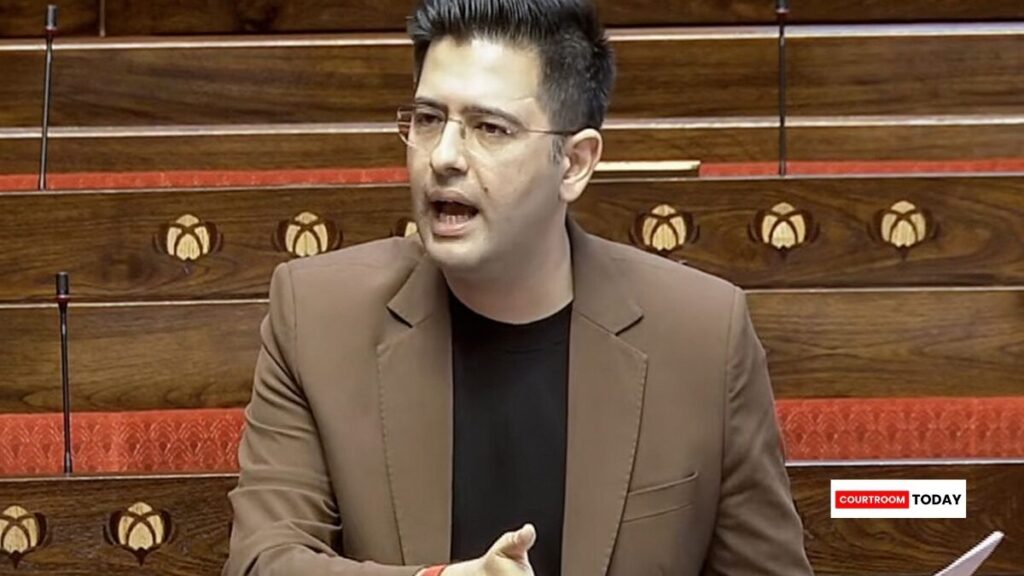
The Delhi High Court, in Raghav Chadha v. Ashok Kumar, partly allowed Rajya Sabha MP Raghav Chadha’s plea seeking removal of certain AI-generated deepfake videos and manipulated content allegedly harming his reputation.
Justice Subramonium Prasad held that public figures must accept political criticism and satire as part of democratic life. However, the Court clarified that vulgar, profane or malicious AI-generated material that seriously damages dignity may justify judicial protection.
Chadha had approached the Court against unidentified persons who allegedly circulated deepfake videos, morphed photographs, manipulated audio and synthetic media using his face, voice, mannerisms and public identity.
He alleged that the material was created to spread false information and damage his political standing. According to the suit, the circulation of such content increased after changes concerning his political affiliations and alliances.
Although the original suit also raised personality rights claims, Chadha informed the Court that he would not press that issue. He restricted the interim application to defamation and sought removal of the allegedly harmful material.
The Court examined whether the three established requirements for a temporary injunction were satisfied: a prima facie case, balance of convenience and the likelihood of irreparable injury that could not be adequately compensated through damages.
Referring to established defamation law, the Court noted that pre-trial restraints on publication must remain exceptional because they directly affect freedom of speech and expression. Interim protection may ordinarily be granted only when material is clearly malicious or palpably false.
The Court reiterated that “those who fill a public position must not be too thin-skinned in reference to comments made upon them”. Persons exercising public power must remain open to criticism, including strong political commentary.
It further observed that “a public figure should not be so thin-skinned so as to complain about any criticism of his decisions and such criticism ought to be viewed with humility”.
The Court expressed concern over the increasing misuse of artificial intelligence to create deepfakes, morphed images and manipulated recordings. It stated that such technology must not be used to harm an individual’s dignity or constitutional right to reputation.
At the same time, the Court recognised that AI has also become a medium for political expression. It said “…a fair balance is to be struck with an individual’s freedom of speech and expression which is also granted under the Constitution of India.”
After reviewing the material, the Court found that most posts involved political satire concerning Chadha’s decisions, party alliances, governance and public policies. Such content, though unpleasant, formed part of political discourse and could not automatically be treated as defamatory.
However, Documents 2, 8, 9, 11, 25 and 40 were found to contain explicit, profane and vulgar material exceeding permissible satire. The concerned platforms were directed to remove the identified URLs within two weeks.
The platforms were also ordered to provide basic subscriber information and IP logs connected with the relevant accounts within two weeks. The remaining content was not restrained because public figures are expected to tolerate legitimate satire and political criticism.
——————————————–
Have a case update, article, or deal to share? Courtroom Today welcomes contributions from lawyers, law firms, and legal professionals. Write to contact@courtroomtoday.com