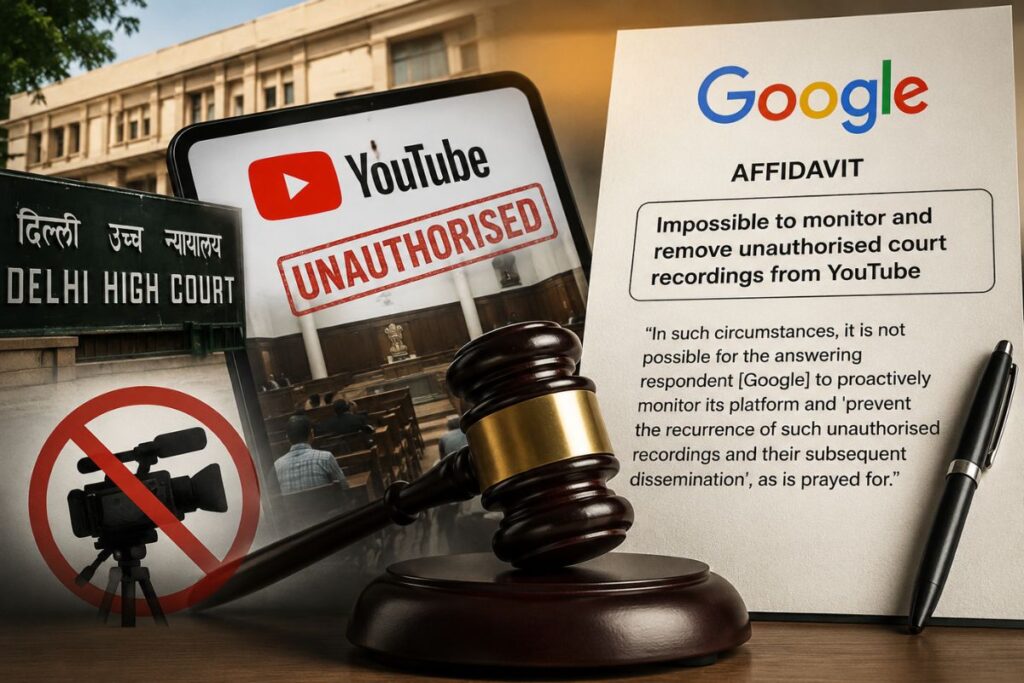
Google has informed the Delhi High Court that it is not technically or legally possible for YouTube to proactively detect and prevent the upload or re-upload of unauthorised recordings of court proceedings. The submission was made in response to a petition seeking stricter action against such content appearing on the platform.
In an affidavit before the High Court, Google argued that directing social media platforms to stop the recurrence of unauthorised court recordings is impractical because the recordings are created outside YouTube. The company said it has no independent way to determine whether a video contains court proceedings, whether the recording was authorised, or whether it violates applicable law.
The technology company further pointed out that court rules governing recordings differ across jurisdictions in India. As a result, it cannot automatically identify which videos are unlawful or whether a particular upload breaches court directions.
Google stated,
“In such circumstances, it is not possible for the answering respondent [Google] to proactively monitor its platform and ‘prevent the recurrence of such unauthorised recordings and their subsequent dissemination’, as is prayed for.”
The company also emphasised that its legal obligation arises only after a competent court identifies specific content as unlawful. According to Google, it can remove or block videos only when they are specifically identified through their URLs and have been adjudicated to violate the law.
The affidavit added that YouTube hosts millions of videos, making it impossible to manually monitor all uploads for possible unauthorised court recordings. Google maintained that Indian intermediary laws do not require platforms to actively monitor user-generated content or independently decide whether a particular video is illegal.
It further submitted,
“Intermediaries such as the Answering Respondent cannot be expected to perform an adjudicatory function and cannot be expected to judge as to which of the removal requests received by it are legitimate and which are not. The determination of the legality legitimacy of content must be made by a competent Court.”
The affidavit was filed in proceedings arising from a petition by advocate Vaibhav Singh. The plea sought action against individuals who uploaded videos showing former Delhi Chief Minister Arvind Kejriwal addressing Justice Swarana Kanta Sharma during a hearing concerning his request for the judge’s recusal in the excise policy case.
Following that hearing, clips of the courtroom proceedings circulated widely across social media platforms. The petitioner also requested directions requiring social media companies to prevent future uploads of unauthorised court recordings.
The Delhi High Court had earlier expressed concern over the growing circulation of such recordings, observing that the issue affects the institutional integrity of the judiciary and requires effective control. Google informed the Court that the specific videos identified by the petitioner have already been removed or blocked for users in India.
——————————————–
Have a case update, article, or deal to share? Courtroom Today welcomes contributions from lawyers, law firms, and legal professionals. Write to contact@courtroomtoday.com