
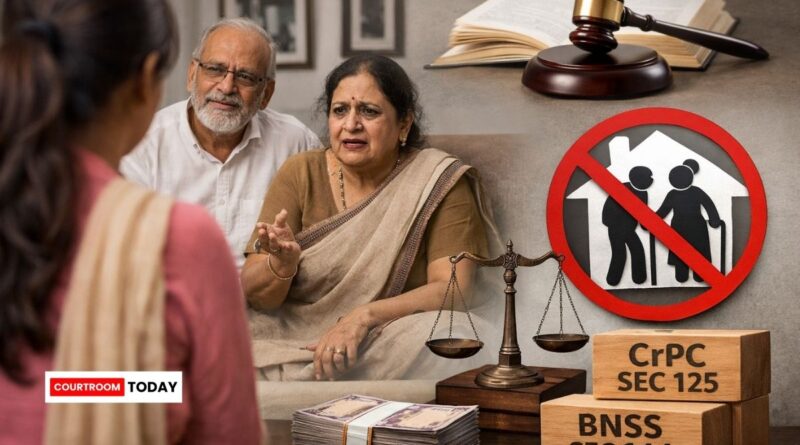
Allahabad High Court Rules Daughter-in-Law Not Legally Bound to Maintain Parents-in-Law
The Allahabad High Court has clarified that a daughter-in-law is not legally obligated to maintain her parents-in-law under existing maintenance laws. The ruling came while deciding a criminal revision petition filed by elderly parents-in-law seeking financial support from their widowed daughter-in-law.
The case arose from a challenge to an order passed by a Family Court in Agra, which had earlier rejected the maintenance application filed under Section 144 of the Bharatiya Nagarik Suraksha Sanhita, 2023 (BNSS). The applicants approached the High Court, arguing that the decision was arbitrary and failed to consider their vulnerable condition.
The parents-in-law contended that they were elderly, financially weak, and had been dependent on their son during his lifetime. After his death in 2021, they claimed that their daughter-in-law, who is employed as a constable in the Uttar Pradesh Police and has a stable income, should be directed to maintain them. They also argued that she had received service and retirement benefits of their deceased son, strengthening her obligation towards them.
Emphasising the moral aspect, the petitioners submitted that their daughter-in-law had a duty to support them and that such moral responsibility should be recognised as a legal obligation. However, the counsel appearing for the daughter-in-law opposed the plea, stating that there was no legal provision requiring her to maintain her parents-in-law.
Justice Madan Pal Singh, while hearing the matter, examined the scope of maintenance provisions under Section 125 of the Code of Criminal Procedure (CrPC) and Section 144 of the BNSS. The Court observed that the right to claim maintenance is purely statutory and is limited to categories expressly mentioned in the law.
The Court noted that the legislature, in its wisdom, has not included parents-in-law within the scope of these provisions. Therefore, a daughter-in-law cannot be compelled to maintain them under these laws. It further clarified that courts cannot expand the scope of statutory provisions based on equitable or moral considerations.
Importantly, the Court drew a clear distinction between moral and legal obligations. It was observed that while a moral duty may exist, it cannot be enforced as a legal liability in the absence of a specific statutory provision.
The High Court also rejected the argument relating to inheritance and service benefits, stating that such issues fall outside the limited scope of summary maintenance proceedings and cannot be adjudicated in such cases.
In light of these observations, the Court upheld the Family Court’s order and dismissed the criminal revision petition filed by the parents-in-law. The judgment reinforces that maintenance claims under criminal law are strictly governed by statutory provisions and cannot be extended beyond the categories clearly defined by the legislature.
——————————————–
Have a case update, article, or deal to share? Courtroom Today welcomes contributions from lawyers, law firms, and legal professionals. Write to contact@courtroomtoday.com