Bombay High Court Fines Litigant Rs 50,000 for Filing Fake AI-Generated Case Law
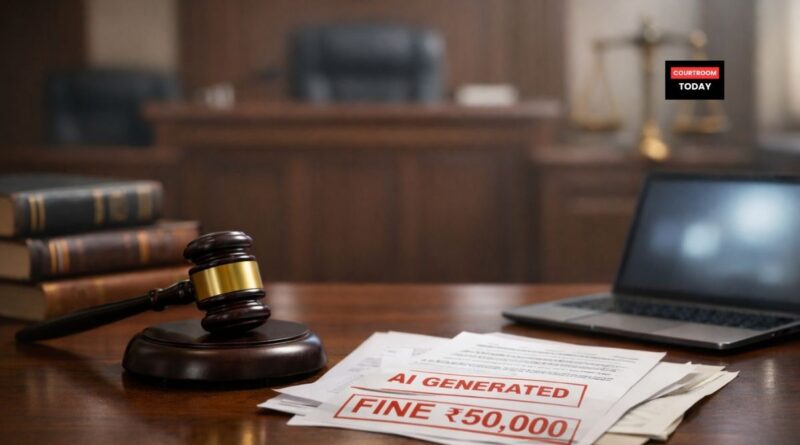
In Deepak Shivkumar Bahry v. Heart & Soul Entertainment Ltd. (Writ Petition No. 8390 of 2009), the Bombay High Court imposed a cost of ₹50,000 on a litigant for submitting written arguments generated using Artificial Intelligence (AI) that relied on a non-existent court judgment, strongly criticising the irresponsible use of such tools in judicial proceedings.
The order was passed by Justice Milind Sathaye, who was hearing a dispute between two film producers concerning a residential flat located in Oshiwara, Mumbai. The dispute was governed by the provisions of the Maharashtra Rent Control Act, 1999.
During the course of the proceedings, the respondent, Mohammed Yasin, appeared as a party-in-person and filed written submissions in February and April 2025. In these submissions, he relied upon an alleged judgment titled Jyoti w/o Dinesh Tulsiani v. Elegant Associates.
However, the Court noted that neither the judge nor the court staff could locate any such judgment. The case was not available in law reports, online databases, or even on the internet. The absence of a citation or a copy of the judgment further raised serious concerns.
Justice Sathaye observed that the submissions carried clear indicators of AI-generated content, including repetitive phrasing, bullet-point formatting, green tick marks, and generic language. The Court concluded that the submissions were likely prepared using an AI tool such as ChatGPT or a similar platform.
While acknowledging that the use of AI tools for legal research is not prohibited, the Court stressed that such tools must be used with great caution and responsibility. The judge observed that any party or advocate relying on AI-generated material has a duty to independently verify the accuracy, relevance, and existence of the references cited.
The Court strongly deprecated the practice of filing unverified or irrelevant material and described it as “dumping” documents on the judiciary. Such conduct, the Court noted, does not assist the judicial process and instead acts as a serious obstacle to the timely delivery of justice.
Justice Sathaye further warned that if advocates are found indulging in similar practices, stricter action may be taken, including referral to the Bar Council.
As a consequence, the Court directed the respondent to pay ₹50,000 as costs to the High Court Employees Medical Fund within two weeks and to submit proof of payment before the Registry.
On the merits of the case as well, the Court found no substance in the respondent’s arguments. The respondent was therefore directed to vacate the suit flat immediately and hand over possession to the petitioner.
——————————————–
Have a case update, article, or deal to share? Courtroom Today welcomes contributions from lawyers, law firms, and legal professionals. Write to contact@courtroomtoday.com