
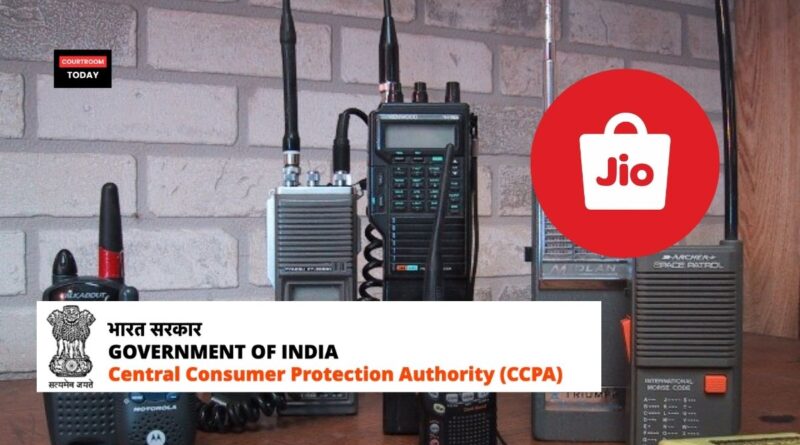
CCPA Penalises JioMart Rs 1 Lakh for Listing Walkie-Talkies Without Mandatory Approvals
The Central Consumer Protection Authority (CCPA) has ordered Reliance Retail’s JioMart platform to pay a penalty of ₹1 lakh after finding that the website listed and sold walkie-talkies without providing compulsory legal disclosures.
A Bench led by Chief Commissioner Nidhi Khare with Commissioner Anupam Mishra held that the platform had engaged in misleading promotion and unfair trade practices under the Consumer Protection Act, 2019.
The regulator began proceedings on its own after noticing that several walkie-talkie devices were displayed on JioMart without any information on whether they required licences or whether they followed wireless spectrum rules.
The Authority pointed out that the use and sale of walkie-talkies in India are regulated by the Indian Wireless Telegraphy Act, 1933. Frequency management is overseen by the Wireless Planning & Coordination (WPC) Wing of the Ministry of Communications. Only the 446.0–446.2 MHz band is licence-free. Any device operating outside this band must have a licence and Equipment Type Approval (ETA).
According to the CCPA, JioMart’s listings did not mention the operating frequencies, the requirement of licences, or whether ETA/WPC approval had been obtained. Because of these omissions, consumers were likely to assume that the devices could be bought and used freely.
The investigation found that 58 walkie-talkies were sold through the platform without these disclosures. Many of them operated in frequency ranges such as UHF 400–470 MHz, UHF 400–520 MHz, and VHF 130–176 MHz, all of which fall outside the licence-free segment.
Calling these omissions a breach of Sections 2(9) (consumer rights), 2(11) (deficiency in service), 2(28) (misleading advertisements) and 2(47) (unfair trade practices), the Authority stated:
“ETA certification is mandatory for any person listing, manufacturing, or selling wireless equipment in India, as it ensures consumer safety and adherence to the authorised frequency spectrum. Therefore, ETA constitutes essential information that must be disclosed by both the e-commerce entity and the seller. The opposite party thus deliberately concealed crucial information from consumers.”
JioMart said that it operated only as a marketplace and that the responsibility for approvals rested with sellers. It also claimed that listings were removed promptly after receiving the first notice, and that some pages seen by investigators were cached Google pages and not active listings.
The CCPA refused to accept this reasoning, stressing that e-commerce platforms cannot act as passive intermediaries and are obligated under the Consumer Protection (E-commerce) Rules, 2020 to ensure that mandatory information is visible to buyers.
The Authority stated:
“Platforms such as the opposite party cannot function merely as passive intermediaries. E-commerce entities are required to take reasonable steps to prevent the listing and sale of prohibited or non-compliant products, as well as other illegal activities on their platform.”
The Authority also noted that the company did not cooperate fully, as it failed to provide ETA/WPC details despite repeated notices.
Using its powers under Sections 20 and 21 of the Consumer Protection Act, the CCPA directed:
- a penalty of ₹1,00,000 for misleading advertisements and unfair trade practices;
- that JioMart must ensure no walkie-talkie or any other regulated product is listed or sold without the required approvals and disclosures;
- A compliance report to be submitted within 15 days.
JioMart was represented by its in-house legal team.
——————————————–
Have a case update, article, or deal to share? Courtroom Today welcomes contributions from lawyers, law firms, and legal professionals. Write to contact@courtroomtoday.com