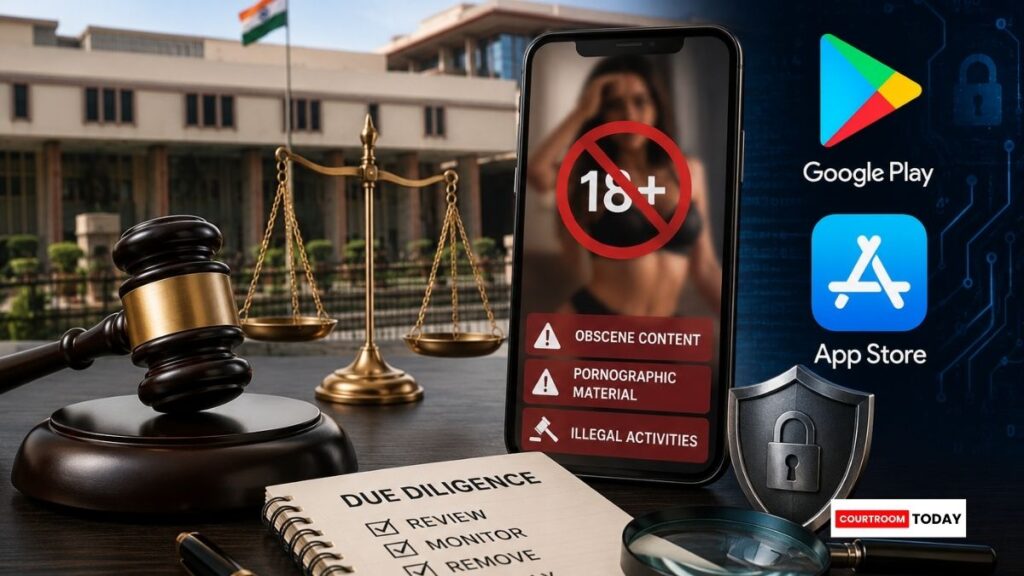
In Rubika Thapa v. Union of India & Ors, the Delhi High Court on Wednesday directed Google LLC and Apple Inc. to strictly ensure that obscene and pornographic content circulated through applications available on their play stores is immediately checked and controlled. The Court stressed that intermediaries cannot remain passive and must exercise due diligence before allowing such applications to be uploaded.
A division bench comprising Chief Justice DK Upadhyaya and Justice Tejas Karia was hearing a public interest litigation filed by Rubika Thapa regarding the alleged failure of authorities and digital platforms to curb apps promoting vulgar, obscene, and pornographic material.
The petitioner argued that several mobile applications available on Google and Apple play stores are allegedly being used not only for obscene live streaming but also for facilitating serious criminal activities. These activities allegedly include prostitution, immoral trafficking, substance abuse, illegal arms trade, extortion, and organised crime.
Advocate Tanmaya Mehta, appearing for the petitioner, submitted that the content available on these applications was “worse than pornographic material” and that such platforms were increasingly becoming tools for honey traps and extortion rackets.
During the hearing, counsel appearing for Google LLC informed the Court that the company already has a robust mechanism in place and that applications violating norms can be removed upon receiving complaints.
However, the High Court observed that the issue was not limited to responding after complaints are made. The bench clarified that intermediaries are also expected to proactively examine applications before permitting them on their platforms.
The Court referred to the Information Technology (Intermediary Guidelines and Digital Media Ethics Code) Rules, 2021, and observed that intermediaries have an important responsibility under the framework. The bench said they are required to act not only after complaints are received but also while allowing applications to operate through their platforms.
Additional Solicitor General Chetan Sharma, appearing for the Union Government, supported the petitioner’s submissions. He emphasised that intermediaries must go a step further in ensuring that such objectionable content is not disseminated through their app stores.
The Court directed Apple Inc., Google LLC, and the Indian Computer Emergency Response Team to strictly ensure compliance with the 2021 Rules and immediately check the dissemination of such videos through applications hosted on their platforms.
The bench also sought an action taken report from the respondents and listed the matter for further hearing on July 17.
The PIL specifically named several applications, including Tango.Me, Pure, Chamet, Bolo Ji, PyaarChat, Bling, StreamKar, LivHub, MuMu, Chato, Vibely, Fun Party, Hiiclub Pro, Jalwa, and Winku.
According to the plea, many of these platforms allegedly feature explicit live streams involving nudity and obscene content in violation of Sections 67, 67A, and 67B of the Information Technology Act, 2000, along with provisions of the Bharatiya Nyaya Sanhita, 2023.
The petition further claimed that many of the entities operate from foreign jurisdictions, including the United States, Turkey, Japan, Russia, and China, making enforcement under Indian law more difficult. It also alleged that deepfake technology and international financial channels were being used for organised extortion and illegal fund routing, posing threats to public order and national security.
——————————————–
Have a case update, article, or deal to share? Courtroom Today welcomes contributions from lawyers, law firms, and legal professionals. Write to contact@courtroomtoday.com