Delhi High Court Questions Blanket Ban on Protests in Delhi University, Seeks Responses
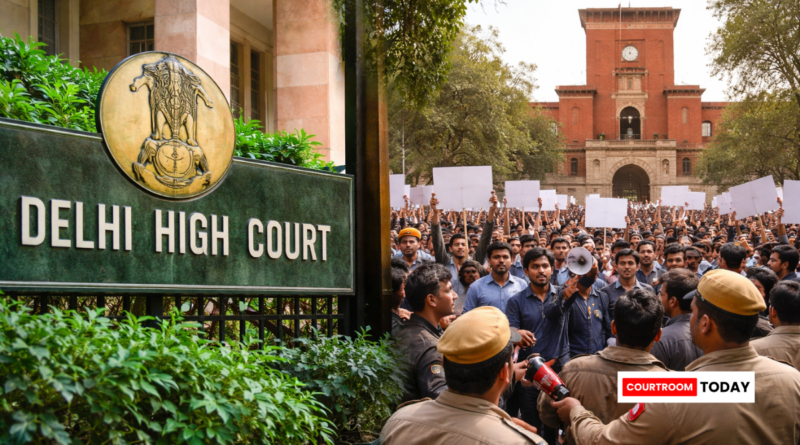
The Delhi High Court has raised concerns over a sweeping restriction on protests across Delhi University campuses, observing that a total prohibition on demonstrations may not be legally justified. However, the Court declined to immediately suspend the orders and will examine the matter further after responses are filed by the authorities.
The Court was hearing a petition filed by Delhi University law student Udhay Bhadoriya, who challenged a notification issued on February 17 by the Office of the Proctor. The notification barred public meetings, rallies, demonstrations, and any assembly of five or more persons across university campuses and affiliated colleges.
A Division Bench of Chief Justice Devendra Kumar Upadhyaya and Justice Tejas Karia noted during the hearing that a blanket restriction on protests appears excessive. The Bench questioned how such an order could justify banning even peaceful demonstrations and rallies.
The Court observed that maintaining law and order is primarily the responsibility of the police. If any protest leads to unlawful activity, authorities already have the power to take action under existing legal provisions. Therefore, imposing a complete ban on all protests may not be appropriate.
During the hearing, the Chief Justice asked why the University found it necessary to issue such a broad order. The Bench remarked, “We are of the clear opinion that there can’t be a blanket ban.” The Court pointed out that the language of the order covers all forms of protests, including peaceful assemblies.
The judges also examined the legal basis for the police restrictions issued under Section 144 of the Code of Criminal Procedure (CrPC) and similar provisions under the Bharatiya Nagarik Suraksha Sanhita (BNSS). The Bench observed that these powers can only be invoked when there is a clear and imminent threat to public order.
According to the Court, mere apprehension is not sufficient to impose such restrictions. Authorities must demonstrate that preventive action is necessary to stop an event that is likely to occur in the near future.
Despite its concerns, the High Court declined to grant interim relief by suspending the orders issued by Delhi University and the Delhi Police. Instead, it directed both authorities to file their responses within one week.
The Court also cautioned students about their conduct. It remarked that the case was being considered primarily because it involves the Article 19 rights of freedom of speech and expression.
At the same time, the Bench emphasised that these freedoms should not be misused. The judges noted that academic authorities would not normally impose such restrictions unless circumstances compelled them to do so.
The restrictions were introduced after clashes during student protests related to the University Grants Commission (UGC) equity guidelines. Following the unrest, some colleges, including Kirori Mal College and Dayal Singh College, issued advisories warning students against participating in protests or sharing related content on social media.
The Delhi Police has also imposed prohibitory orders regarding protests in the area, which have reportedly been extended until April.
The High Court has scheduled the next hearing in the case for March 25, when it will consider the responses from the University and the police before deciding the matter further.
——————————————–
Have a case update, article, or deal to share? Courtroom Today welcomes contributions from lawyers, law firms, and legal professionals. Write to contact@courtroomtoday.com