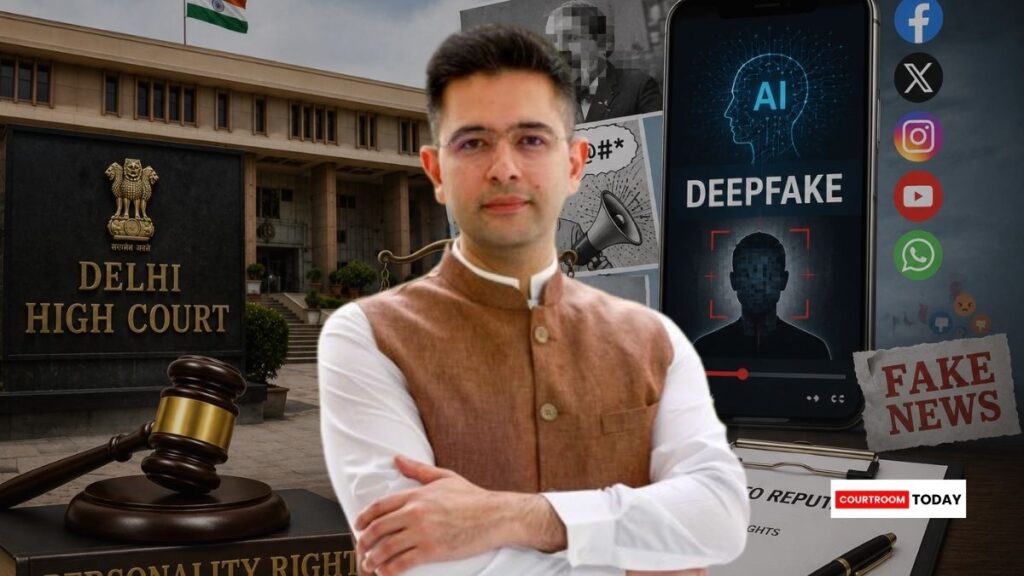
The Delhi High Court on Thursday observed that criticism of a political decision cannot automatically be treated as a violation of personality rights while hearing a plea filed by Rajya Sabha MP Raghav Chadha over alleged AI-generated deepfake content circulated online after his switch from the Aam Aadmi Party to the Bharatiya Janata Party.
Justice Subramonium Prasad remarked that the material flagged by Chadha appeared to be criticism of a political move rather than misuse of personality rights. The Court said political leaders are often subjected to public commentary, satire, and criticism, especially in the digital age.
“Prima facie, there is no personality right involved in this case. A decision taken by you in a political arena is being criticised,” the Court observed during the hearing.
The Bench also referred to the long history of political cartoons and satire in India, mentioning the work of celebrated cartoonist R.K. Laxman. The Court noted that while social media has amplified such content today, criticism of political actions remains part of democratic discourse.
During the proceedings, Senior Advocate Rajiv Nayar, appearing for Chadha, argued that the circulated content went beyond ordinary criticism. He pointed out that certain morphed visuals allegedly showed Prime Minister Narendra Modi showering Chadha with money, while some other images depicted him in a saree.
Nayar submitted that the material was defamatory and damaging to Chadha’s reputation. However, the Court questioned whether such allegations could be pursued under personality rights law.
“This is not a defamation suit. It is a suit on the basis of personality right,” Justice Prasad said, while asking Chadha’s counsel to consider amending the case into a defamation action.
When Nayar responded that the matter was indeed one of defamation, the Court advised him to move an application for amendment of the plaint.
The Court also questioned whether a political leader should be “so sensitive” to criticism and comments circulating online. It emphasised that public figures are routinely exposed to scrutiny and criticism over political decisions.
Chadha’s plea sought directions against AI-generated deepfakes, manipulated videos, synthetic voice cloning, fabricated speeches, and morphed digital content allegedly shared on social media platforms following his political switch.
The Court clarified that it would need to hear the opposing side before granting any interim relief. When Chadha’s counsel stated that there was no identified opposite party, the Bench said it could even appoint an amicus curiae if required.
After hearing the submissions, the Court reserved its order on Chadha’s request for interim relief.
The case adds to the growing number of disputes before Indian courts involving AI-generated content, deepfakes, and personality rights. In recent years, celebrities and public figures including Amitabh Bachchan, Anil Kapoor, and Shashi Tharoor have approached courts seeking protection against unauthorised use of their names, images, voices, and likeness through digital and AI tools.
——————————————–
Have a case update, article, or deal to share? Courtroom Today welcomes contributions from lawyers, law firms, and legal professionals. Write to contact@courtroomtoday.com