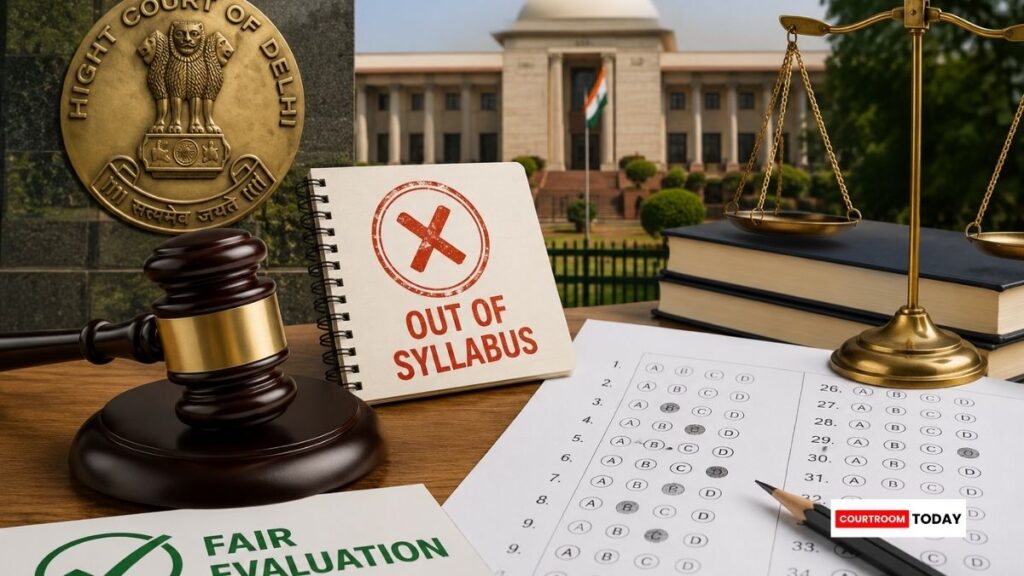
In Arvind And Ors v. Registrar General High Court Of Delhi And Ors, the Delhi High Court has ruled that candidates cannot claim “free marks” for questions later removed from an examination for being outside the prescribed syllabus. The Court upheld the evaluation method adopted in the Junior Judicial Assistant (JJA)/Restorer departmental examination conducted by the Delhi High Court.
A Division Bench of Justices V. Kameswar Rao and Manmeet Pritam Singh Arora dismissed a petition filed by employees working in Group-C posts, including Chauffeurs and Court Attendants. The petitioners had appeared for the departmental examination conducted to fill 71 JJA/Restorer posts under the 25% quota.
The dispute arose after the Examination Cell identified four questions in the Stage-I written examination as being beyond the syllabus. These included three questions from General Knowledge and one from General English. Following objections raised by candidates, the questions were dropped from evaluation.
The petitioners argued that once the questions were declared out of syllabus, every candidate who attempted them should receive full marks. According to them, denying such marks created unequal treatment among candidates and affected fairness in the selection process.
The Delhi High Court, however, accepted the explanation given by the respondents regarding the evaluation process. The respondents stated that the marks assigned to the dropped questions were proportionately redistributed among the remaining valid questions through an extrapolation formula.
They also clarified that candidates who had answered the dropped questions correctly were granted the benefit of those marks wherever it improved their overall score. The Court noted that this method ensured fairness while maintaining the original total marks and qualifying standards.
While examining the process, the Bench observed that the adopted mechanism was neither arbitrary nor discriminatory. The Court held that the extrapolation formula balanced the evaluation process without unfairly benefiting candidates who had answered dropped questions incorrectly.
Rejecting the plea for awarding full marks to all candidates, the Bench observed:
“We see no equitable basis for this claim of the Petitioners for seeking full marks for the dropped questions, which were either wrongly answered.”
The Court further clarified that the Supreme Court’s decision in Kanpur University v. Samir Gupta (1983) did not support the petitioners’ argument for automatic free marks in such situations.
The Bench also noted that the authorities could have completely ignored the dropped questions while calculating scores. Instead, they adopted a more candidate-friendly approach by granting whichever score was higher between the actual marks and extrapolated marks.
Finding no arbitrariness or prejudice caused by the evaluation method, the Delhi High Court ultimately dismissed the writ petition and upheld the examination results.
——————————————–
Have a case update, article, or deal to share? Courtroom Today welcomes contributions from lawyers, law firms, and legal professionals. Write to contact@courtroomtoday.com