In Delhi High Court Bar Association v. Dr. Kapil Kakkar & Ors., the Delhi High Court has held that social media platforms cannot wait for court directions before acting against content that unlawfully targets judges or undermines the judiciary. The Court stressed that intermediaries have a legal duty to act once they become aware of such content.
A Division Bench comprising Justices Neena Bansal Krishna and Madhu Jain referred to Section 79 of the Information Technology Act, 2000. The Bench observed that intermediaries must promptly remove or disable access to information that is being used to commit an unlawful act.
The Court noted that digital platforms play a significant role in modern communication and cannot remain passive when their services are used to spread content that harms public institutions or interferes with the administration of justice.
According to the Bench, once an intermediary gains knowledge that information hosted on its platform is facilitating unlawful activity, it is obligated to remove the material without delay. The Court emphasised that this responsibility exists independently and does not require a prior judicial order in every case.
The observations came while hearing a criminal contempt petition filed by the Delhi High Court Bar Association (DHCBA). The petition challenged a series of videos and posts uploaded by Dr. Kapil Kakkar on various social media platforms.
Kakkar had referred to a sitting High Court judge as a “murderer” in connection with the death of six persons in a building collapse in Delhi’s Saket area. He also made allegations of corruption, collusion and criminal conduct against the judge.
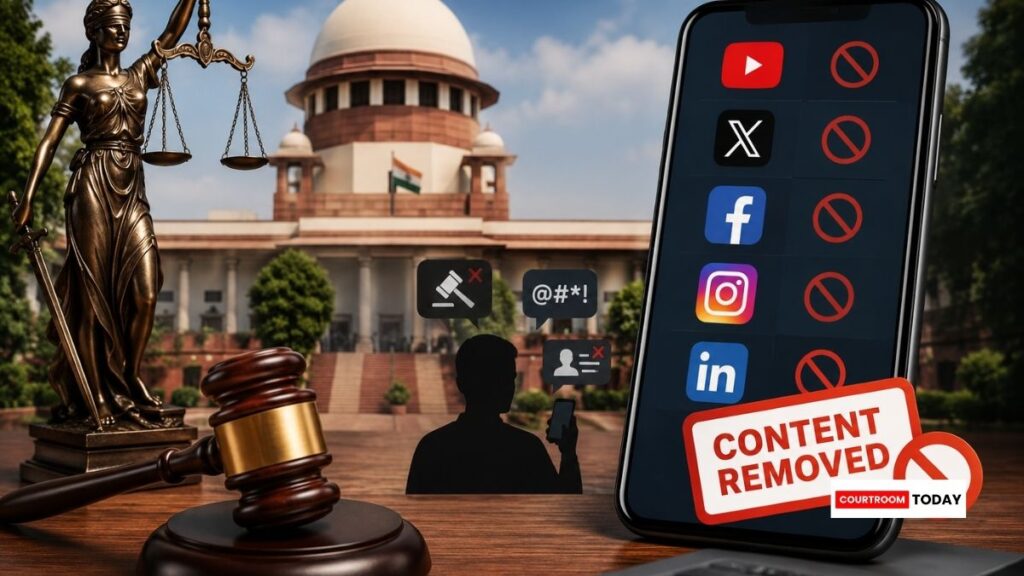
After examining the material, the Court found the statements to be highly objectionable. It ordered YouTube, X, LinkedIn and Meta to block Kakkar’s accounts and remove the impugned content from their platforms.
The Bench clarified that criticism of judicial decisions and institutions is permissible in a democracy. However, it drew a clear distinction between fair criticism and baseless allegations aimed at damaging the reputation and integrity of judges.
The Court observed that attributing corruption, criminality or improper motives to judges without any legal foundation cannot be treated as legitimate criticism. Such conduct, it said, strikes at the independence of the judiciary and the rule of law.
Concluding the matter, the Bench described the videos as “absolutely scandalous, contumacious” and held that they amounted to a direct interference with the justice delivery system. The Court reiterated that while individuals responsible for such acts must face legal consequences, social media platforms must also discharge their statutory obligations without waiting for judicial intervention.
——————————————–
Have a case update, article, or deal to share? Courtroom Today welcomes contributions from lawyers, law firms, and legal professionals. Write to contact@courtroomtoday.com