End of an Era: Supreme Court Closes M.C. Mehta Delhi Pollution PIL After 40 Years
In M.C. Mehta v. Union of India, the Supreme Court has formally closed one of India’s most important environmental cases after nearly 40 years. The public interest litigation, filed in 1985, had become the basis for long-running judicial supervision over pollution control measures in Delhi.
A Bench led by Chief Justice of India Surya Kant, along with Justices Joymalya Bagchi and Vipul M. Pancholi, ended Writ Petition No. 13029/1985. The Court noted that the matter had continued for decades through continuous mandamus and had produced many directions on major environmental concerns.
These directions covered vehicular pollution, industrial emissions, waste handling, and wider environmental governance in the capital. Over time, the case became closely linked with Delhi’s anti-pollution policy, with the Court repeatedly stepping in where administrative action was seen as slow or inadequate.
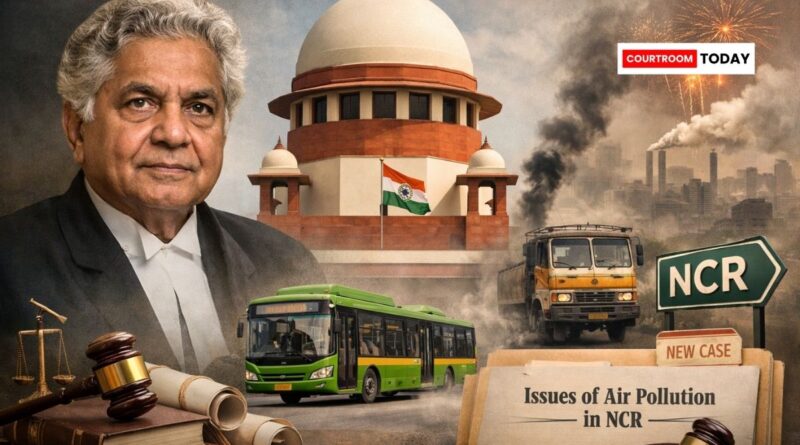
Even though the old petition has now been disposed of, the Court has not stepped away from the issue. It asked the registry to open fresh suo motu proceedings under the title “Issues of Air Pollution in NCR”, ensuring that monitoring of air pollution in the region continues in a new procedural form.
The closure marks the end of a historic chapter in Indian environmental law. Under this litigation, the Supreme Court had ordered several major interventions, including the shift of Delhi’s bus fleet to CNG, restrictions on polluting vehicles, action on industrial pollution, and firecracker-related controls in the NCR.
The case also influenced broader policy steps beyond Delhi. It was connected with the phase-out of leaded petrol in major cities, the creation of the Environment Pollution (Prevention and Control) Authority, and the environment compensation charge imposed on commercial vehicles entering Delhi.
The Court had earlier expressed concern that several old public interest matters were still technically shown as pending because fresh applications kept being filed in them. According to the Bench, this created a misleading picture of pendency and made it necessary to reorganise such long-running cases.
To manage this transition, all pending interlocutory applications in the matter will now be converted into separate writ petitions. These will be grouped issue-wise, including vehicular pollution, air quality, waste management, and power plants, so that future hearings can proceed in a more structured way.
During the hearing, the Court also raised concern about the misuse of PILs. It observed that some petitions appeared to be influenced from outside India and said that in sensitive matters like air pollution, no fresh petitions should be entertained without the Court’s permission.
Environmental lawyer M.C. Mehta reacted to the development by saying, “So many commissions, court-monitored probes, and regulations have come into force. I hope the vigilance continues afterwards.” His petition is widely seen as having shaped environmental jurisprudence and pushed public authorities towards stronger action on clean air in Delhi-NCR.
——————————————–
Have a case update, article, or deal to share? Courtroom Today welcomes contributions from lawyers, law firms, and legal professionals. Write to contact@courtroomtoday.com